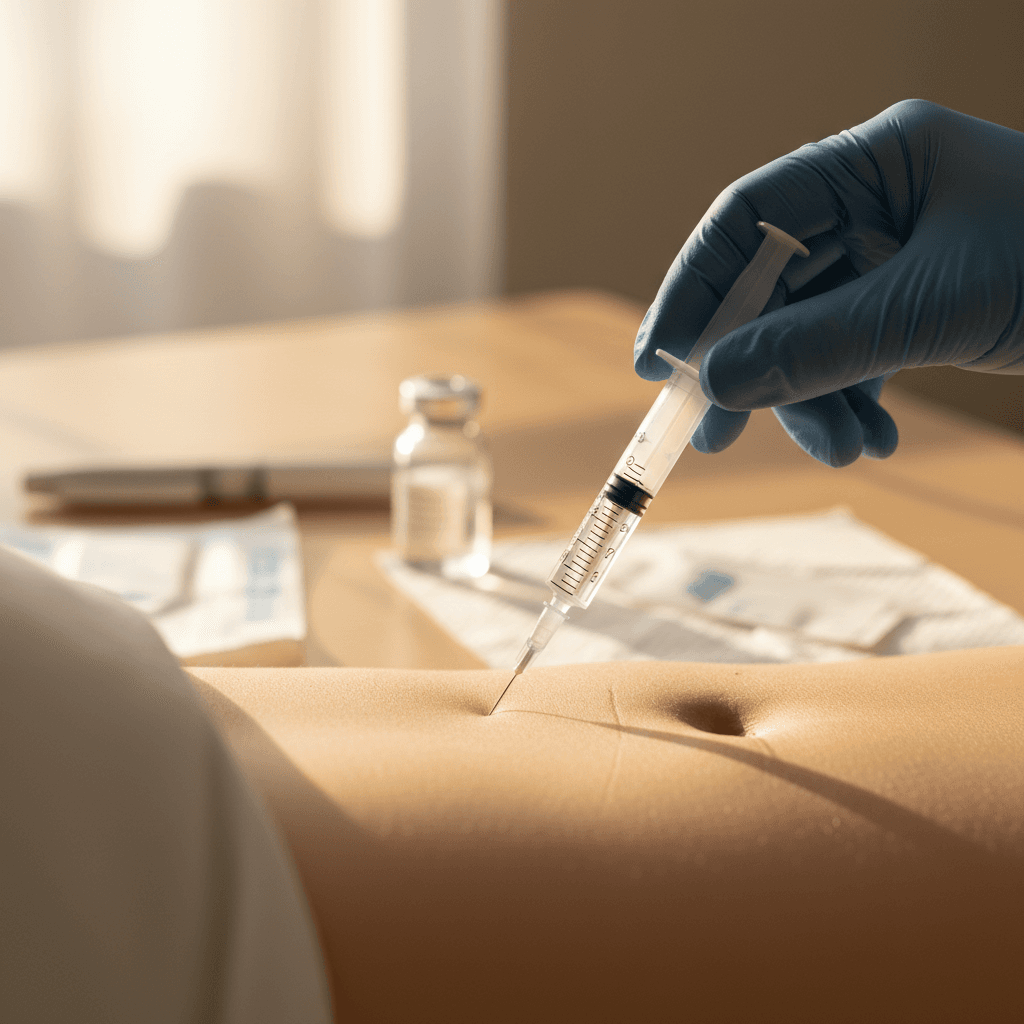
BPC-157 at 250 mcg twice daily is typically given subcutaneously: a pinch of abdominal fat and a 31 gauge half-inch needle are all that is required. It absorbs over several hours, with no muscle penetration needed. TB-500 at 2 mg twice weekly, by contrast, is often administered intramuscularly in the deltoid, where the deeper deposit reaches the bloodstream more quickly.
The choice depends on the peptide, how the body responds, and pain tolerance. The subcutaneous route suits most peptides. It is straightforward, less painful, and mirrors the way the body releases many of these compounds naturally. The intramuscular route is generally reserved for growth or repair peptides that benefit from faster uptake.
Subcutaneous injection: the default route for most peptides
Subcutaneous injection delivers the compound into the fat beneath the skin, roughly 5 to 10 mm deep, and is conventionally given at a 45-degree angle into fatty tissue (Vaccine Administration, CDC Pink Book). Absorption takes 30 minutes to a few hours, which suits sustained effects.
Why subcutaneous suits most peptides
Peptides such as Semaglutide (0.25 mg weekly ramping to 2.4 mg) (Wegovy Prescribing Information, FDA/DailyMed), Tirzepatide (2.5 mg weekly to 15 mg) (Zepbound Prescribing Information, FDA/DailyMed), and Retatrutide (1 mg weekly to start) are given subcutaneously. The fat depot keeps levels steady, avoiding sharp peaks or troughs.
BPC-157 at 250 to 500 mcg daily subcutaneously near an injury supports tendon repair locally without flooding the system. GHK-Cu at 1 mg daily subcutaneously improves skin and collagen at the site.
The Semaglutide calculator works out the subcutaneous volume, for example 0.25 ml from a 1 mg/ml vial.
Needle selection for subcutaneous injection
Use 30-32 gauge insulin syringes with a 0.3 to 0.5 ml capacity and a 5/16 to 1/2 inch length. A thinner needle causes less pain.
A 32G 5/16 inch needle suits small doses under 0.2 ml, such as Ipamorelin 100 mcg.
A 31G 1/2 inch needle is standard for 0.5 ml and covers CJC-1295/Ipamorelin blends at 300 mcg each.
A 30G 1/2 inch needle handles higher volumes, such as AOD-9604 300 mcg in 0.3 ml.
These needles glide into thigh or abdominal fat. Swab the site with alcohol to sterilize, then prime by pushing out 1-2 drops.
The Tirzepatide calculator indicates a 0.1 ml draw for 5 mg from a 10 mg/ml stock, where a 31G needle is well matched.
Subcutaneous sites and rotation
The abdomen is the primary site, 2 inches from the navel and around the belt line (Wegovy Prescribing Information, FDA/DailyMed). Alternate between the left and right quadrants each day.
For the thigh, use the outer mid-thigh and sit down so the muscle relaxes. The back of the upper arm is an option when someone else administers the injection.
The protocol is as follows:
- Clean the site and vial top with alcohol.
- Pinch a 1-2 inch skin fold.
- Use a 45-90 degree angle, 90 degrees for a lean build and 45 degrees where there is more fat.
- Insert quickly. Inject slowly over 5-10 seconds.
- Release the pinch. Hold for 5 seconds, then withdraw straight out.
- Do not rub. Dab if it bleeds.
PT-141 at 500 mcg subcutaneously 30 minutes beforehand works best in the abdomen, with effects appearing within an hour. Move sites 1-2 inches each time to avoid lumps.
A representative daily stack is Semaglutide 1 mg subcutaneously in the morning into the abdomen and Ipamorelin 200 mcg subcutaneously in the evening into the thigh. The Ipamorelin calculator gives the draw.
Optimizing subcutaneous absorption
Room-temperature peptides absorb best. Warm the vial in the hand for 2 minutes before injecting. Some users wait 30 minutes before eating after a weight-loss peptide such as MOTS-c 5 mg weekly.
To limit scar tissue, keep to a maximum of 1 ml per site and space injections 1 cm apart. Itching may indicate the solution has aged; replace with fresh bacteriostatic water every 30 days.
Selank is available as a nasal spray, which bypasses injection, but 300 mcg daily in the thigh is an alternative for those who prefer to inject.
Intramuscular injection: faster uptake for muscle peptides
Intramuscular injection reaches the muscle, roughly 25 to 50 mm deep, and is conventionally given at a 90-degree angle (Vaccine Administration, CDC Pink Book). The muscle's blood supply takes it up in 15-30 minutes, which suits growth hormone pulses.
When intramuscular is preferable
TB-500 at 2 to 2.5 mg intramuscularly twice weekly near injuries supports faster repair. HGH 2 IU intramuscularly before bed produces a more natural pulse for some individuals.
Sermorelin 300 mcg intramuscularly in the evening, Ipamorelin/CJC-1295 at 100/100 mcg intramuscularly for growth hormone spikes, and DSIP 100 mcg intramuscularly, which induces sleep quickly, are further examples.
The BPC-157 calculator also covers intramuscular dosing at 500 mcg, although the subcutaneous route keeps BPC-157 more localized.
Intramuscular injection accommodates larger volumes, for example 1 ml HGH or TB-500 blends.
Needle selection for intramuscular injection
Use 25-27 gauge needles, 1 to 1.5 inch long. A shorter needle suits the deltoid and a longer one the glutes.
A 27G 1 inch needle suits the deltoid or thigh with under 0.5 ml, such as Sermorelin.
A 25G 1 inch needle suits the quads or glutes with 1 ml TB-500.
A 25G 1.5 inch needle suits the glutes in individuals over 100 kg.
Use 1-3 ml syringes for larger volumes. Draw with an 18G needle, then switch to the injection needle.
The TB-500 calculator for a 4 mg vial gives 1 ml intramuscularly at 4 mg/ml.
Intramuscular sites and aspiration
Deltoid: the upper outer arm, a thumb-width below the shoulder, up to 0.5 ml (Vaccine Administration, CDC Pink Book).
Vastus lateralis: the midpoint of the outer thigh, comfortably up to 1 ml (Vaccine Administration, CDC Pink Book).
Gluteus: the upper outer quadrant, with the ventrogluteal site being the safest, up to 2 ml.
The protocol is as follows:
- Landmark the site by feeling the bone and muscle edges.
- Clean the site and stretch the skin taut.
- Use a 90 degree angle and insert quickly.
- Aspirate by pulling back on the plunger for 5 seconds to check for blood. If none appears, inject slowly over 20-30 seconds.
- Use a Z-track if preferred, angling out 10 degrees on withdrawal.
- Massage gently for 10 seconds.
A representative schedule is HGH 4 IU intramuscularly into the deltoid on Monday, Wednesday, and Friday. Always aspirate; hitting a vein is rare but possible.
The HGH calculator gives, for example, 0.4 ml for a 10 IU/ml preparation.
Intramuscular rotation and reducing pain
Use one site per week at most: deltoids in week 1, thighs or glutes in week 2.
Ice the site for 1 minute beforehand to numb it, warm the vial, and breathe out on insertion.
A representative TB-500 protocol is 2.5 mg intramuscularly into the deltoid on Monday and 2.5 mg intramuscularly into the thigh on Thursday, loading for 4 weeks, then 2 mg weekly for maintenance.
Subcutaneous versus intramuscular: a peptide-by-peptide comparison
| Peptide | Best Method | Dose Example | Site | Needle | Why |
|---|---|---|---|---|---|
| BPC-157 | Subq | 250 mcg 2x/day | Near injury/abdomen | 31G 0.5" | Localized heal |
| Semaglutide | Subq | 1 mg weekly | Abdomen | 31G 0.5" | Steady GLP-1 |
| Retatrutide | Subq | 4 mg weekly | Abdomen | 30G 0.5" | Weight loss slow release |
| Tirzepatide | Subq | 5 mg weekly | Abdomen | 31G 0.5" | Dual agonist absorption |
| TB-500 | IM | 2 mg 2x/week | Delt/thigh | 27G 1" | Fast systemic repair |
| Ipamorelin | Subq or IM | 200 mcg nightly | Thigh or delt | 31G 0.5" or 27G 1" | GH pulse flexible |
| CJC-1295/Ipamorelin | IM preferred | 300/300 mcg nightly | Delt | 27G 1" | Synergy peak |
| GHK-Cu | Subq | 1 mg daily | Face/abdomen | 32G 5/16" | Skin target |
| PT-141 | Subq | 500 mcg 2h pre | Abdomen | 31G 0.5" | Steady libido |
| Sermorelin | IM | 300 mcg nightly | Thigh | 27G 1" | Natural GH ramp |
| AOD-9604 | Subq | 300 mcg AM | Abdomen | 30G 0.5" | Fat burn |
| DSIP | IM | 100 mcg bedtime | Delt | 27G 1" | Quick sleep |
| Selank | Subq (rare) | 300 mcg daily | Thigh | 32G 0.5" | Nasal alt better |
| Semax | Subq (rare) | 300 mcg daily | Arm | 32G 0.5" | Nasal primary |
| MOTS-c | Subq | 5 mg weekly | Abdomen | 30G 0.5" | Metabolic slow |
| HGH | IM | 2 IU nightly | Delt | 27G 1" | Pulse mimic |
Subcutaneous injection wins on ease, and most people prefer it. Intramuscular injection may absorb 10-20% better for some peptides, according to anecdotal user logs.
A simple self-comparison is possible: run Ipamorelin subcutaneously for 2 weeks while logging energy and sleep, then switch to intramuscular for 2 weeks. Intramuscular injection feels sharper to many users, though subcutaneous injection tends to hold effects better over the longer term.
Technique refinements
Common mistakes and fixes
Bleeding on a subcutaneous injection suggests the needle was too shallow; pinch harder. Bleeding on an intramuscular injection suggests a missed aspiration.
Lumps point to cold peptide or a rushed injection. Warm the solution and inject slowly.
An absence of effect points to the wrong depth or an aged vial. Check the reconstitution date.
Pain points to a dull needle. Use a fresh one or ice the site first.
Reconstitute accurately. A BPC-157 5 mg vial plus 3 ml bacteriostatic water yields 1.67 mg/ml, so 0.15 ml delivers 250 mcg. See the CJC-1295/Ipamorelin calculator.
Store in the fridge at 2-8 C and warm to hand temperature before injecting.
For stacks, give subcutaneous Semaglutide into the abdomen in the morning and intramuscular TB-500 into the deltoid in the evening, spacing them 6 hours apart.
For microdosing HGH, split 1 IU subcutaneously into 0.5 IU in the morning and 0.5 IU in the evening, or give 1 IU intramuscularly in the evening. Subcutaneous injection smooths IGF-1 more evenly.
Storage and preparation across methods
Bring vials to room temperature 1 hour before use. Do not microwave. Do not shake peptides; roll the vial gently.
Use bacteriostatic water only, at 0.9%. A multi-dose vial lasts 28 days in the fridge.
Travel with an ice pack and inject the same day.
For GHK-Cu given subcutaneously to the face, swab thoroughly with sterile technique and use 1 mg in 0.1 ml with a 32G needle.
Troubleshooting injection issues
For a bruise, apply arnica gel afterward and rotate to the next site.
For a hard lump, apply a warm compress for 10 minutes twice a day; it usually resolves within 48 hours.
For signs of infection, such as redness, heat, and swelling, stop all injections. Antibiotics are needed if pus is present.
For an allergic itch, test with 50 mcg first.
For intramuscular soreness, stretch the site for 5 minutes afterward.
Keep a log of date, peptide, dose, site, method, and effects on a 1-10 scale.
This is for informational purposes. Consult a healthcare professional before using any peptides, as individual responses vary and proper medical supervision is essential.
References
- Vaccine Administration, CDC Pink Book Chapter 6 (subcutaneous 45 degree angle into fatty tissue, intramuscular 90 degree angle, needle gauge and length, deltoid and vastus lateralis sites). https://www.cdc.gov/pinkbook/hcp/table-of-contents/chapter-6-vaccine-administration.html
- Wegovy (semaglutide) Prescribing Information, FDA/DailyMed (0.25 mg weekly start, 4-week titration to 2.4 mg maintenance, subcutaneous abdomen/thigh/upper arm). https://dailymed.nlm.nih.gov/dailymed/drugInfo.cfm?setid=ee06186f-2aa3-4990-a760-757579d8f77b
- Zepbound (tirzepatide) Prescribing Information, FDA/DailyMed (2.5 mg weekly start, 2.5 mg increments to 15 mg maximum, subcutaneous abdomen/thigh/upper arm, rotate sites). https://www.dailymed.nlm.nih.gov/dailymed/drugInfo.cfm?setid=487cd7e7-434c-4925-99fa-aa80b1cc776b