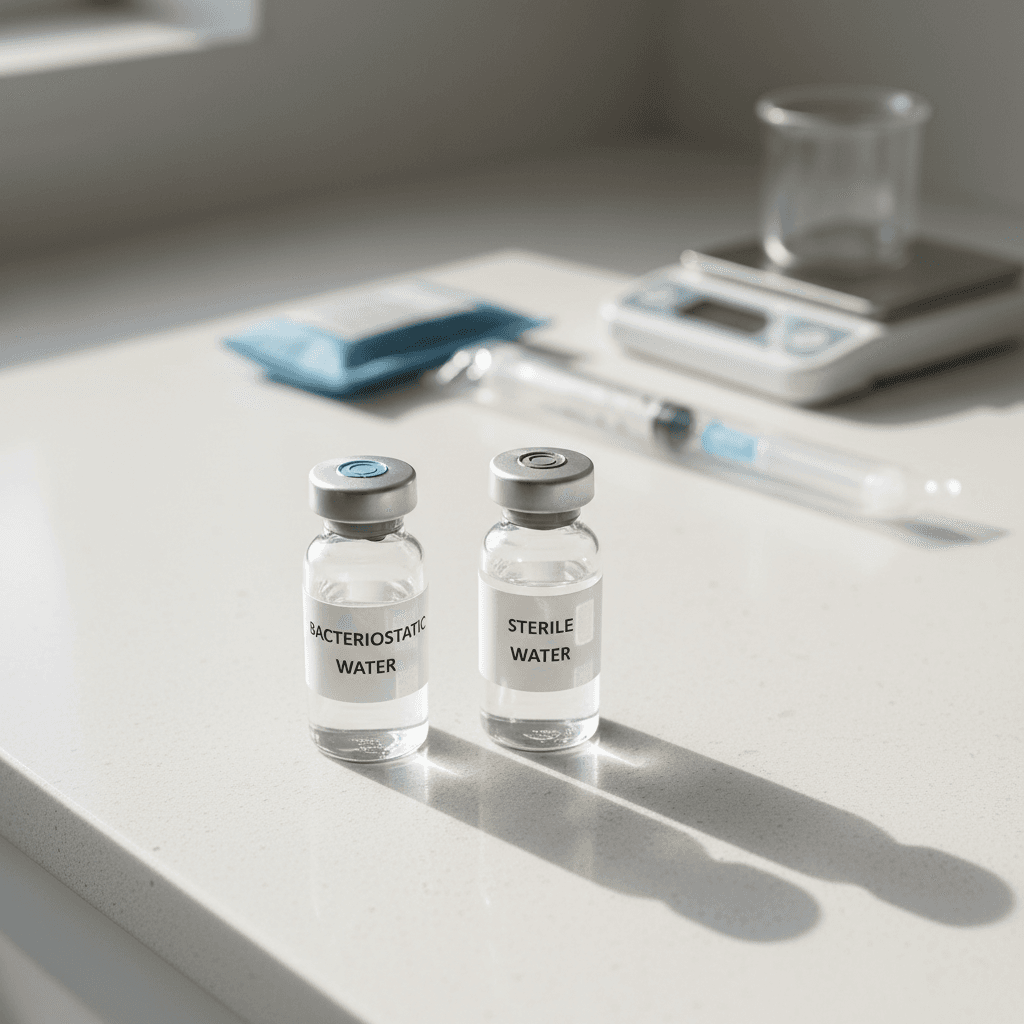
Bacteriostatic water contains 0.9% benzyl alcohol as a preservative (Bacteriostatic Water for Injection, USP, DailyMed/FDA). Sterile water does not (Sterile Water for Injection, USP, DailyMed/FDA). That single difference determines which one is appropriate and for how long.
Bacteriostatic Water (BAC Water)
Bacteriostatic water is sterile water with 0.9% benzyl alcohol added. The benzyl alcohol inhibits bacterial growth, which allows the water to be entered repeatedly by a needle over multiple days (Bacteriostatic Water for Injection, USP, DailyMed/FDA).
Key properties:
- Contains 0.9% benzyl alcohol
- Inhibits (does not kill) bacterial growth
- Safe for multi-dose vials
- 28-day shelf life after first puncture
- Available in 10ml and 30ml vials
- Requires refrigeration after opening
BAC water is the standard choice for peptide reconstitution. Because most peptide vials are used over days or weeks, with one dose drawn at a time, the preservative keeps the solution safe between uses.
Sterile Water for Injection
Sterile water for injection (SWFI) is purified water that has been sterilized and contains no additives. It is free of preservatives, antimicrobial agents, and buffers (Sterile Water for Injection, USP, DailyMed/FDA).
Once a sterile water vial is punctured, bacteria from the needle, even a clean one, can enter. Without preservative, those bacteria multiply freely, and the solution can become contaminated within hours.
When to Use Which
Use bacteriostatic water when:
- Reconstituting a multi-dose peptide vial
- The vial will be accessed over multiple days
- The protocol spans days or weeks, which is nearly all peptide protocols
This covers the vast majority of peptide use cases. Peptides such as BPC-157 (dosed 2x daily for weeks), semaglutide (dosed weekly), and CJC-1295/Ipamorelin (dosed daily) all require BAC water because the same vial is accessed repeatedly.
Use sterile water when:
- The entire reconstituted vial will be used in a single session
- The peptide manufacturer specifically requires it
- The individual is sensitive or allergic to benzyl alcohol (rare, but possible)
- Preparing IV formulations (never use BAC water intravenously)
Shelf Life Comparison
| Property | Bacteriostatic Water | Sterile Water |
|---|---|---|
| Unopened shelf life | 2+ years (check expiry) | 2+ years (check expiry) |
| After first puncture | 28 days | Use immediately |
| Storage | Room temp unopened, refrigerate after opening | Room temp until use |
| Multi-dose safe | Yes | No |
The 28-day window for BAC water aligns with public health guidance that a multi-dose vial should be discarded within 28 days of first entry unless the manufacturer specifies otherwise (Injection Safety: Multi-dose Vials, CDC). It also matches most reconstituted peptide shelf lives. BPC-157 and semaglutide both last 28 days reconstituted. TB-500 and sermorelin last about 21 days.
Benzyl Alcohol Sensitivity
The 0.9% benzyl alcohol in BAC water is safe for the vast majority of people, but some individuals experience reactions. True benzyl alcohol allergy is rare, though sensitivity is somewhat more common.
Symptoms of benzyl alcohol sensitivity:
- Redness, swelling, or a raised welt at the injection site that lasts more than an hour
- Itching or burning that persists well after injection (not just the brief sting during)
- Hives around the injection site
- Hardened lumps that take days to resolve
A small, brief sting when injecting BAC water is normal. That is the benzyl alcohol itself, and it happens to everyone. The concern is when the reaction is disproportionate, spreads beyond the injection point, or worsens with each injection.
Alternatives for sensitive individuals:
- Use sterile water for injection and treat each vial as single-use. Reconstitute only enough for one dose at a time, or split a vial across multiple syringes and discard within 24 hours.
- Ask a compounding pharmacy about sodium chloride 0.9% (normal saline) for injection if the specific peptide is compatible with it.
- Some peptide vendors sell BAC water with lower benzyl alcohol concentrations (0.45%). This is not standard USP, but may reduce irritation for sensitive users.
If sensitivity is suspected, a single reconstitution cycle with sterile water can show whether injection site reactions improve. Resolution of the reactions confirms the benzyl alcohol as the cause.
How to Check USP Labeling
Not all BAC water sold online actually meets pharmaceutical standards. The following elements should appear on the label before purchase.
Required label elements for USP-grade BAC water:
- "Bacteriostatic Water for Injection, USP" (the full designation)
- Benzyl alcohol concentration listed as 0.9%
- "For intravenous, intramuscular, or subcutaneous use" (or similar injection-use language)
- Manufacturer name and lot number
- Expiration date
- "Rx only" or "For prescription use"
If the label says "bacteriostatic water" but lacks "USP" anywhere, it has not been verified against pharmacopeia standards and should be avoided. If it lists a benzyl alcohol concentration other than 0.9% (such as 1.5% or 2%), it is not standard BAC water and should not be used for peptide reconstitution.
Red flags to watch for:
- No lot number or expiration date
- Sold in non-pharmaceutical packaging (such as bulk jugs or squeeze bottles)
- Label says "for laboratory use only" or "not for human use"
- Unusually cheap pricing (a 30ml vial of genuine USP BAC water typically costs $5-15)
Shelf Life After Opening BAC Water
An unopened vial of BAC water lasts until the printed expiration date, which is typically 2-3 years from manufacture. Once the rubber stopper is punctured with a needle, the 28-day countdown begins (Injection Safety: Multi-dose Vials, CDC).
Why 28 days? Each needle puncture creates a microscopic channel through the stopper. The benzyl alcohol inhibits bacterial growth, but it does not sterilize. Over time, repeated punctures introduce more potential contaminants. After 28 days, the cumulative risk exceeds what the preservative can reliably handle.
Practical tips for tracking:
- Write the date of first puncture directly on the vial with a permanent marker
- If several peptides are reconstituted on the same day, one 10ml BAC water vial is usually enough for all of them
- Do not save a half-used BAC water vial for next month. Start a fresh one
A 10ml vial is enough to reconstitute 3-5 peptide vials at 2ml each. A 30ml vial lasts longer but increases the number of needle punctures before it is used up. For most people, 10ml vials are the better choice.
Recommended BAC Water Volume by Peptide
The table below shows common reconstitution volumes. These are not the only valid options, but they place a typical dose in a syringe-friendly range (5-20 units per dose).
| Peptide | Vial Size | Recommended BAC Water | Resulting Concentration |
|---|---|---|---|
| BPC-157 | 5mg | 2ml | 2,500mcg/ml |
| Semaglutide | 5mg | 2ml | 2,500mcg/ml |
| Tirzepatide | 5mg | 2ml | 2,500mcg/ml |
| Tirzepatide | 10mg | 2ml | 5,000mcg/ml |
| TB-500 | 5mg | 2ml | 2,500mcg/ml |
| TB-500 | 10mg | 2ml | 5,000mcg/ml |
| CJC-1295/Ipamorelin | 5mg | 2.5ml | 2,000mcg/ml |
| Sermorelin | 5mg | 2ml | 2,500mcg/ml |
| GHK-Cu | 5mg | 2ml | 2,500mcg/ml |
| AOD-9604 | 5mg | 2ml | 2,500mcg/ml |
| PT-141 | 10mg | 2ml | 5,000mcg/ml |
| Selank | 5mg | 2ml | 2,500mcg/ml |
| Semax | 5mg | 2ml | 2,500mcg/ml |
| DSIP | 2mg | 1ml | 2,000mcg/ml |
| MOTS-c | 10mg | 2ml | 5,000mcg/ml |
These volumes are starting points. Use the peptide calculators on this site to adjust based on the actual vial size and preferred dose.
Where to Buy BAC Water
Bacteriostatic water is available from:
- Compounding pharmacies (highest reliability, often available without a prescription for the water itself)
- Medical supply websites (look for established suppliers such as Hospira, Pfizer, or generic USP manufacturers)
- Amazon and general retailers (check for USP grade, read recent reviews, verify seller ratings)
Always look for "USP" on the label. This confirms the water meets United States Pharmacopeia standards for purity and benzyl alcohol concentration.
Typical pricing:
- 10ml vial: $3-8
- 30ml vial: $5-15
- Multi-pack of 10ml vials (5-pack): $15-30
Pricing significantly above this range indicates overpayment. Pricing significantly below it should raise the question of whether the product is genuine USP-grade.
Sterile water for injection is available from:
- Pharmacies (often behind the counter)
- Medical supply distributors
- Some peptide vendors include it with orders
Sterile water is best purchased in small single-use ampules rather than large vials, which removes any incentive to reuse an open container.
A Note on Other Liquids
Do not use saline (0.9% sodium chloride) unless the peptide manufacturer specifically calls for it. Some peptides are sensitive to salt concentration. Do not use distilled water from a grocery store, as it is not sterile. Do not use any water that is not explicitly labeled for injection use.
The correct choice for nearly every peptide reconstitution scenario is bacteriostatic water. A small supply of 10ml vials on hand covers months of typical use.
References
- Bacteriostatic Water for Injection, USP (Hospira, Inc.). DailyMed / FDA prescribing label. https://dailymed.nlm.nih.gov/dailymed/fda/fdaDrugXsl.cfm?setid=87d6e9dc-fe3b-4593-ac9a-d7493d1959c7
- Sterile Water for Injection, USP (Fresenius Kabi USA, LLC). DailyMed / FDA prescribing label. https://dailymed.nlm.nih.gov/dailymed/fda/fdaDrugXsl.cfm?setid=e71c6c83-d518-496c-b2ab-efd5987e4783
- Injection Safety: Questions about multi-dose vials. Centers for Disease Control and Prevention (CDC), Clinical Safety. https://www.cdc.gov/injection-safety/hcp/clinical-safety/index.html