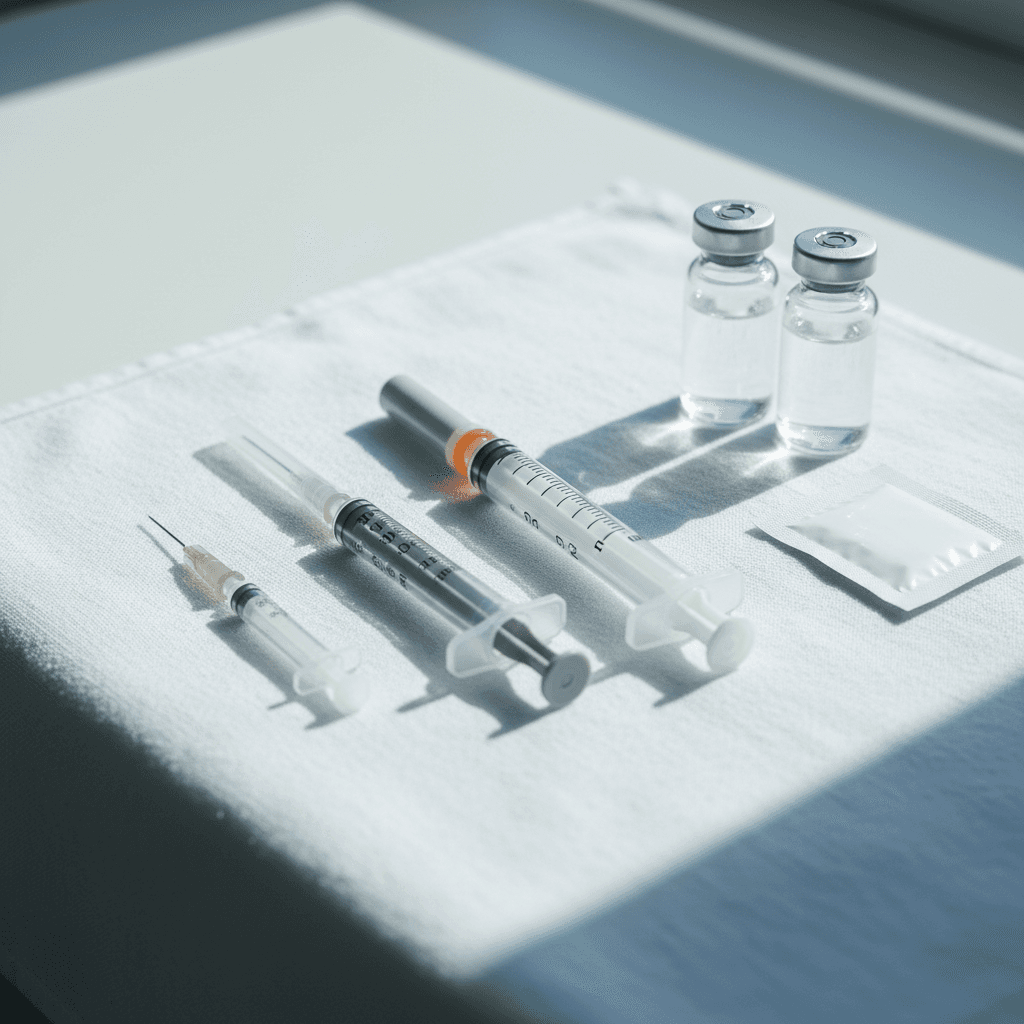
Insulin syringes measure volume in "units," not milliliters. On every standard U-100 insulin syringe, 100 units equals 1ml (HUMULIN R U-100 Prescribing Information, DailyMed/FDA). This means each unit is 0.01ml. Once that conversion is understood, every peptide dose calculation becomes straightforward.
Syringe Sizes
Insulin syringes come in three common sizes. The internal scale differs, but the unit-to-ml ratio is always the same.
100-Unit Syringe (1ml)
- Total capacity: 100 units (1.0ml)
- Markings: Every 2 units, with numbered lines at 10, 20, 30, etc.
- Best for: Larger doses, reconstituting (adding water to the vial)
This is the most common syringe. It holds the most volume, which makes it useful for reconstitution and for peptides that require larger injection volumes. The downside is that small doses (under 10 units) are harder to measure precisely because the markings are close together.
50-Unit Syringe (0.5ml)
- Total capacity: 50 units (0.5ml)
- Markings: Every 1 unit, with numbered lines at 5, 10, 15, etc.
- Best for: Medium doses, good balance of precision and capacity
The 50-unit syringe is a solid middle ground. Individual unit lines are spaced farther apart than on the 100-unit syringe, making small increments easier to read. Many users prefer this size for daily peptide dosing.
30-Unit Syringe (0.3ml)
- Total capacity: 30 units (0.3ml)
- Markings: Every 1 unit (sometimes every 0.5 units), numbered at 5, 10, 15, etc.
- Best for: Small, precise doses
The 30-unit syringe offers the highest precision. Each unit marking is wide and easy to read. If the calculated dose is under 30 units, this syringe provides the most accurate measurement. It works well for peptides like BPC-157 (typical doses of 5-10 units) or sermorelin.
How to Read the Markings
Hold the syringe at eye level with the needle pointing up. The plunger has a rubber gasket inside the barrel. Read the volume at the top edge of the gasket (the edge closest to the needle), not the bottom edge.
Example on a 100-unit syringe:
- The plunger's top rubber edge sits at the "10" line = 10 units = 0.1ml
- Halfway between "10" and "20" = 15 units = 0.15ml
- At the "5" line = 5 units = 0.05ml
Quick conversion table:
| Units | Milliliters |
|---|---|
| 5 | 0.05ml |
| 10 | 0.10ml |
| 15 | 0.15ml |
| 20 | 0.20ml |
| 25 | 0.25ml |
| 50 | 0.50ml |
| 100 | 1.00ml |
Use the peptide calculators on this site to convert a desired mcg dose into units. The calculator accounts for vial size and water volume, removing the need for manual calculation.
Gauge Sizes
The gauge number refers to the needle's outer diameter. Higher gauge means thinner needle.
29 Gauge (29g)
The thickest commonly used for insulin and peptide injections. It draws liquid faster and is slightly more noticeable on insertion. A good general-purpose choice.
30 Gauge (30g)
A step thinner. Very common for subcutaneous peptide injections. It offers a good balance between comfort and draw speed. Most users cannot feel the difference between 29g and 30g.
31 Gauge (31g)
The thinnest standard option. Insertion is nearly painless. It takes slightly longer to draw liquid, making it best for small-volume injections where draw speed does not matter.
For most peptide users, 29g or 30g works well. The comfort difference between gauges is minimal for subcutaneous injection.
Needle Lengths
Insulin syringes typically come with fixed (non-removable) needles in two lengths.
1/2 Inch (12.7mm)
Standard length. Works for both subcutaneous and shallow intramuscular injections. Suitable for most body compositions. This is the most widely available option.
5/16 Inch (8mm)
Shorter needle. Designed for subcutaneous injection only. Preferred by leaner individuals or those injecting in areas with less subcutaneous fat (like the upper arm). Also more comfortable for daily injections.
Which Syringe for Which Purpose
| Task | Recommended Syringe |
|---|---|
| Reconstituting (adding water) | 100-unit (1ml) |
| Doses above 30 units | 50-unit or 100-unit |
| Doses 10-30 units | 30-unit or 50-unit |
| Doses under 10 units | 30-unit |
| Semaglutide weekly dose | 50-unit or 100-unit |
| BPC-157 daily dose | 30-unit or 50-unit |
| CJC-1295/Ipamorelin daily dose | 30-unit or 50-unit |
Use a separate syringe for reconstitution and for dosing. The needle dulls after puncturing the rubber stopper, making the injection less smooth. Many users keep a box of 100-unit syringes for reconstitution and a box of 30-unit syringes for daily injections.
Low Dead Space Syringes
Standard insulin syringes have a small gap between the needle hub and the plunger's lowest point. This gap traps a tiny amount of liquid (typically 0.03-0.07ml) that cannot be expelled. This is called "dead space."
For most peptide users, dead space is a minor issue, amounting to a few lost units per injection. When dosing an expensive peptide at small volumes, or combining peptides in the same syringe, those lost units add up.
Low dead space (LDS) syringes reduce that gap to nearly zero (under 0.01ml). They are designed so the needle seats flush against the plunger path.
When LDS syringes make sense:
- Doses under 5 units, where 0.05ml of waste is a large percentage of the total dose
- Expensive peptides, where recovering every dose from a vial matters
- Vials that are nearly empty
When they do not matter:
- Standard dosing of 10+ units from a reasonably sized vial
- Reconstitution (the dead space loss is negligible relative to the water volume)
LDS syringes are slightly more expensive. A box of 100 typically costs $5-10 more than standard syringes. They are available from medical supply retailers and some pharmacies.
How to Prime a Syringe and Remove Air Bubbles
Air bubbles in a subcutaneous syringe are not dangerous. A small air bubble injected under the skin is absorbed by the body harmlessly. However, bubbles take up space in the syringe barrel, which reduces the amount of peptide delivered. The steps below remove them.
Step-by-step:
- Draw the dose from the vial as normal.
- Hold the syringe with the needle pointing straight up.
- Tap the barrel firmly with a fingernail. This dislodges bubbles from the walls and floats them to the top near the needle.
- Push the plunger up slowly until the air exits through the needle. Stop as soon as a tiny drop of liquid appears at the needle tip.
- Check the volume. If too much liquid was expelled, draw a bit more from the vial to reach the target.
If a bubble is stuck and will not float up: Flick the syringe barrel 4-5 times with a finger. The vibration breaks the bubble free. Alternatively, pull the plunger back slightly to create more space, tap again, then push the air out.
For very small doses (under 5 units), even a tiny bubble matters proportionally. Take the extra 10 seconds to clear it.
The Syringe Reuse Debate
Some people reuse insulin syringes to save money. This carries several risks.
Needle dulling. An insulin needle is sharpest on its first use. After one puncture through a rubber stopper, the tip bends and burrs at a microscopic level. After a second puncture (into the skin), it is duller still. A third use will be noticeably less comfortable. Studies show that needle sharpness degrades measurably after a single use.
Contamination risk. Once a needle has contacted skin or a non-sterile surface, it carries bacteria. The syringe barrel is also exposed to air once the cap is removed. Reuse introduces those bacteria into the peptide vial on the next draw, contaminating the entire remaining supply (Preventing Unsafe Injection Practices, CDC).
Cost perspective. A box of 100 insulin syringes costs $12-20 depending on size and brand. That is $0.12-0.20 per syringe. There is no meaningful financial reason to reuse them.
Use each syringe once. Draw, inject, dispose.
Needle Disposal
Used needles belong in a sharps container. Every time, without exception.
What counts as a sharps container:
- FDA-cleared sharps disposal containers (red, puncture-resistant, available at pharmacies for $5-10)
- A heavy-duty plastic container with a screw-on lid (like a laundry detergent jug) works as a substitute if labeled "SHARPS" (Safely Using Sharps, FDA)
What to do when the container is full: Disposal rules vary by state and municipality. Common options include:
- Drop-off at pharmacies (Walgreens, CVS, and many independents accept sharps containers)
- Household hazardous waste collection sites
- Mail-back programs (some sharps container manufacturers include a prepaid return envelope)
- Supervised drop-off at hospitals or health departments
Never throw loose needles in household trash. Never put them in recycling. Never flush them. In many states, improper sharps disposal is a fineable offense.
Check local regulations. Many state health department websites offer a sharps disposal locator tool that identifies the nearest option.
Syringe Brand Comparison
Brand quality varies. The commonly available options below show how they compare.
| Brand | Sizes Available | Gauge Options | Notable Features | Typical Price (100ct) |
|---|---|---|---|---|
| BD Ultra-Fine | 30u, 50u, 100u | 29g, 30g, 31g | Industry standard, widely available, consistent quality | $15-22 |
| Easy Touch | 30u, 50u, 100u | 27g, 28g, 29g, 30g, 31g | Budget-friendly, good quality for the price, wide gauge selection | $10-16 |
| Exel | 50u, 100u | 29g, 30g, 31g | Reliable, often found at medical supply stores | $10-15 |
| Nipro | 50u, 100u | 29g, 30g | Smooth plunger action, less common in retail | $12-18 |
| UltiCare | 30u, 50u, 100u | 29g, 30g, 31g | Comfort point technology, good for daily use | $12-18 |
BD Ultra-Fine is the most widely recommended and is stocked at nearly every pharmacy. Easy Touch is the leading budget option and performs well. The differences between brands are small. Select one available in the preferred size and gauge, and use it consistently.
References
- HUMULIN R U-100 (regular insulin human injection) Prescribing Information, DailyMed/FDA. https://dailymed.nlm.nih.gov/dailymed/drugInfo.cfm?setid=9ec3e28a-cea9-4e45-9057-e5bf8e37014c
- Preventing Unsafe Injection Practices, Injection Safety, Centers for Disease Control and Prevention (CDC). https://www.cdc.gov/injection-safety/hcp/clinical-safety/index.html
- Safely Using Sharps (Needles and Syringes) at Home, at Work and on Travel, U.S. Food and Drug Administration (FDA). https://www.fda.gov/medical-devices/consumer-products/safely-using-sharps-needles-and-syringes-home-work-and-travel