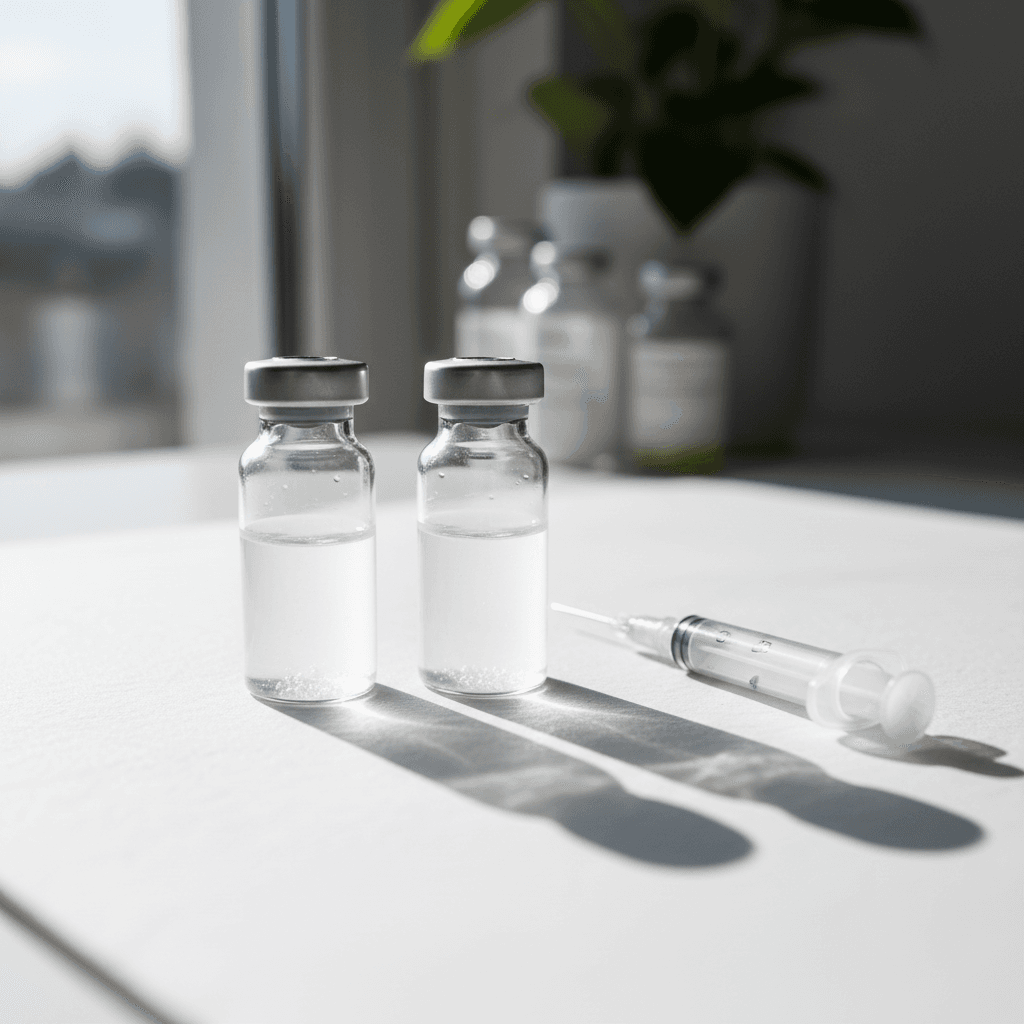
Tirzepatide hits two receptors. Semaglutide hits one. That matters.
In the SURMOUNT-1 trial, participants on 15 mg tirzepatide lost a mean of about 20.9% of their body weight over 72 weeks (treatment-policy estimand; the on-treatment completer estimate ran higher, around 22.5%) (Jastreboff NEJM 2022). Semaglutide at 2.4 mg in the STEP 1 trial produced about 14.9% weight loss over 68 weeks (Wilding NEJM 2021). Both numbers are striking. But the gap between them tells you something about how these drugs actually work.
This guide breaks down the mechanisms, dosing schedules, reconstitution specifics, and side effects so you can figure out which one fits your situation.
How they work
Semaglutide
Semaglutide is a synthetic version of human GLP-1, sharing about 94% structural homology (Lau et al., J Med Chem 2015). It binds to GLP-1 receptors and does four things:
- Boosts insulin secretion from pancreatic beta cells (glucose-dependent, so it scales with your blood sugar)
- Suppresses glucagon, cutting your liver's glucose output
- Slows gastric emptying, keeping food in your stomach longer so you feel full
- Reduces appetite through direct action on the brain's hunger centers
Its half-life is roughly 165 hours (about 7 days), which is why you inject once a week instead of daily like older GLP-1 drugs.
Tirzepatide
Tirzepatide is a dual GIP/GLP-1 receptor agonist. It does everything semaglutide does, plus it activates GIP (glucose-dependent insulinotropic polypeptide) receptors. That second receptor adds another insulin secretion pathway and appears to amplify the metabolic effects beyond what GLP-1 alone achieves.
Its half-life is about 116 hours (roughly 5 days). Still long enough for weekly dosing, but shorter than semaglutide's. You may notice the effects tapering slightly toward the end of the week, especially at lower doses.
Dosing schedules
Semaglutide titration
Each dose step lasts a minimum of 4 weeks. Rushing the titration is the main reason people get hit hard by nausea.
| Phase | Dose | Frequency |
|---|---|---|
| Weeks 1-4 | 0.25mg (250mcg) | Weekly |
| Weeks 5-8 | 0.5mg (500mcg) | Weekly |
| Weeks 9-12 | 1.0mg (1000mcg) | Weekly |
| Weeks 13-16 | 1.7mg (1700mcg) | Weekly |
| Week 17+ | 2.4mg (2400mcg) | Weekly |
The 2.4mg dose is the target for weight management. For type 2 diabetes, some people stay at 1.0mg or 2.0mg depending on response. Not everyone needs to reach the maximum.
Use our semaglutide reconstitution calculator for weight loss for dose conversion and reconstitution math.
Tirzepatide titration
Same 4-week minimum per step, but more total steps to climb through:
| Phase | Dose | Frequency |
|---|---|---|
| Weeks 1-4 | 2.5mg (2500mcg) | Weekly |
| Weeks 5-8 | 5.0mg (5000mcg) | Weekly |
| Weeks 9-12 | 7.5mg (7500mcg) | Weekly |
| Weeks 13-16 | 10mg (10,000mcg) | Weekly |
| Weeks 17-20 | 12.5mg (12,500mcg) | Weekly |
| Week 21+ | 15mg (15,000mcg) | Weekly |
Many people see significant results at 10mg and never go to 15mg. If the side effects are manageable and the weight is moving, there is no rule that says you must max out.
Our Tirzepatide calculator handles dilution calculations and dose scheduling.
Head-to-head comparison
| Factor | Semaglutide | Tirzepatide |
|---|---|---|
| Receptor target | GLP-1 only | GIP + GLP-1 |
| Administration | Weekly subcutaneous | Weekly subcutaneous |
| Starting dose | 0.25mg (250mcg) | 2.5mg (2500mcg) |
| Maximum dose | 2.4mg (weight) / 2.0mg (diabetes) | 15mg |
| Half-life | ~165 hours (~7 days) | ~116 hours (~5 days) |
| Avg weight loss (trials) | ~14.9% (STEP 1, 68 weeks) | ~20.9% (SURMOUNT-1, 72 weeks; 15 mg arm) |
| Full titration time | ~16 weeks | ~20 weeks |
On effectiveness: Tirzepatide outperformed semaglutide in every head-to-head measure from clinical trials. But "average" hides a lot of variation. Some people respond better to semaglutide. Some can't tolerate tirzepatide's GI effects. If cost or availability is a factor, semaglutide at 2.4mg still produces dramatic results for most people.
On side effects: The profiles overlap heavily. Nausea, vomiting, diarrhea, constipation, and reduced appetite are common with both. These peak during titration and usually fade within 2-3 weeks at each new dose. Tirzepatide tends to cause slightly more GI distress at higher doses, likely because of the dual receptor action.
Reconstitution and preparation
If you are working with lyophilized (freeze-dried) peptide, you need to reconstitute before injecting. Precision here directly affects your dosing accuracy.
Semaglutide reconstitution
A typical research vial contains 5mg of semaglutide. Adding 2ml of bacteriostatic water gives you a concentration of 2.5mg/ml (2500mcg/ml). At that concentration:
- 0.25mg dose = 0.1ml (10 units on an insulin syringe)
- 0.5mg dose = 0.2ml (20 units)
- 1.0mg dose = 0.4ml (40 units)
If your vial is 3mg, add 1.2ml for the same 2.5mg/ml concentration. Adjust the math for whatever vial size you have.
Tirzepatide reconstitution
Tirzepatide vials are commonly 5mg, 10mg, or 30mg. For a 10mg vial, adding 2ml of bacteriostatic water gives you 5mg/ml (5000mcg/ml):
- 2.5mg dose = 0.5ml (50 units)
- 5.0mg dose = 1.0ml (100 units)
For a 30mg vial, 3ml of bacteriostatic water gives you 10mg/ml, which keeps injection volumes small at higher doses:
- 5.0mg dose = 0.5ml (50 units)
- 10mg dose = 1.0ml (100 units)
- 15mg dose = 1.5ml (150 units)
Prep rules
- Let the vial reach room temperature before adding water (15-20 minutes on the counter)
- Use bacteriostatic water, not plain sterile water, if you plan to use the vial across multiple doses. Bacteriostatic water contains 0.9% benzyl alcohol, which inhibits bacterial growth
- Aim the stream of water down the glass wall of the vial, not directly onto the powder
- Swirl gently. Do not shake. Shaking denatures the peptide
- Store reconstituted vials in the refrigerator at 2-8C (36-46F). Most reconstituted peptides remain stable for about 28 days refrigerated
Side effects
Both drugs share this list:
- Nausea (most common, affects 20-40% of users during titration)
- Vomiting
- Diarrhea or constipation
- Abdominal pain
- Reduced appetite (this is partly how they work, not purely a side effect)
- Headache
What to watch for
Pancreatitis: Severe, persistent abdominal pain radiating to your back warrants immediate medical attention. Rare, but real.
Thyroid concerns: GLP-1 agonists caused thyroid C-cell tumors in rodent studies. If you or your family have a history of medullary thyroid carcinoma or MEN2 syndrome, these drugs are contraindicated.
Hypoglycemia: Low risk on its own. The risk goes up if you combine these with insulin or sulfonylureas.
Practical tips
- Follow the titration. The 4-week steps exist for a reason. Jumping ahead to save time usually means worse nausea and a higher chance of quitting
- Log everything. Track your dose, injection site, weight, and any side effects weekly. Patterns emerge fast
- Eat smaller meals. These drugs slow your digestion. Large meals on a slowed stomach feel terrible
- Rotate injection sites. Abdomen, thigh, upper arm. Move at least 1 inch from your last spot
- Drink more water than you think you need. GI side effects dehydrate you, and dehydration makes nausea worse
- If you miss a dose, take it within 3 days of the scheduled day. If more than 3 days have passed, skip it and resume on your next scheduled day
Which one should you pick?
If you want maximum weight loss and can handle a longer titration with potentially rougher side effects, tirzepatide has the stronger clinical data. If semaglutide is easier to get, more affordable, or you respond well to it, there is no reason to switch. Both drugs are effective. The best one is the one you can take consistently.
References
- Wilding JPH et al. "Once-Weekly Semaglutide in Adults with Overweight or Obesity." NEJM, 2021. PubMed
- Lincoff AM et al. "Semaglutide and Cardiovascular Outcomes in Obesity without Diabetes." NEJM, 2023. PubMed
- Jastreboff AM et al. "Tirzepatide Once Weekly for the Treatment of Obesity." NEJM, 2022. PubMed
- Aronne LJ et al. "Tirzepatide as Compared with Semaglutide for the Treatment of Obesity." NEJM, 2025. PubMed
Disclaimer: This article is not medical advice. Both semaglutide and tirzepatide are prescription medications. Work with a qualified healthcare provider before starting, adjusting, or stopping either drug.