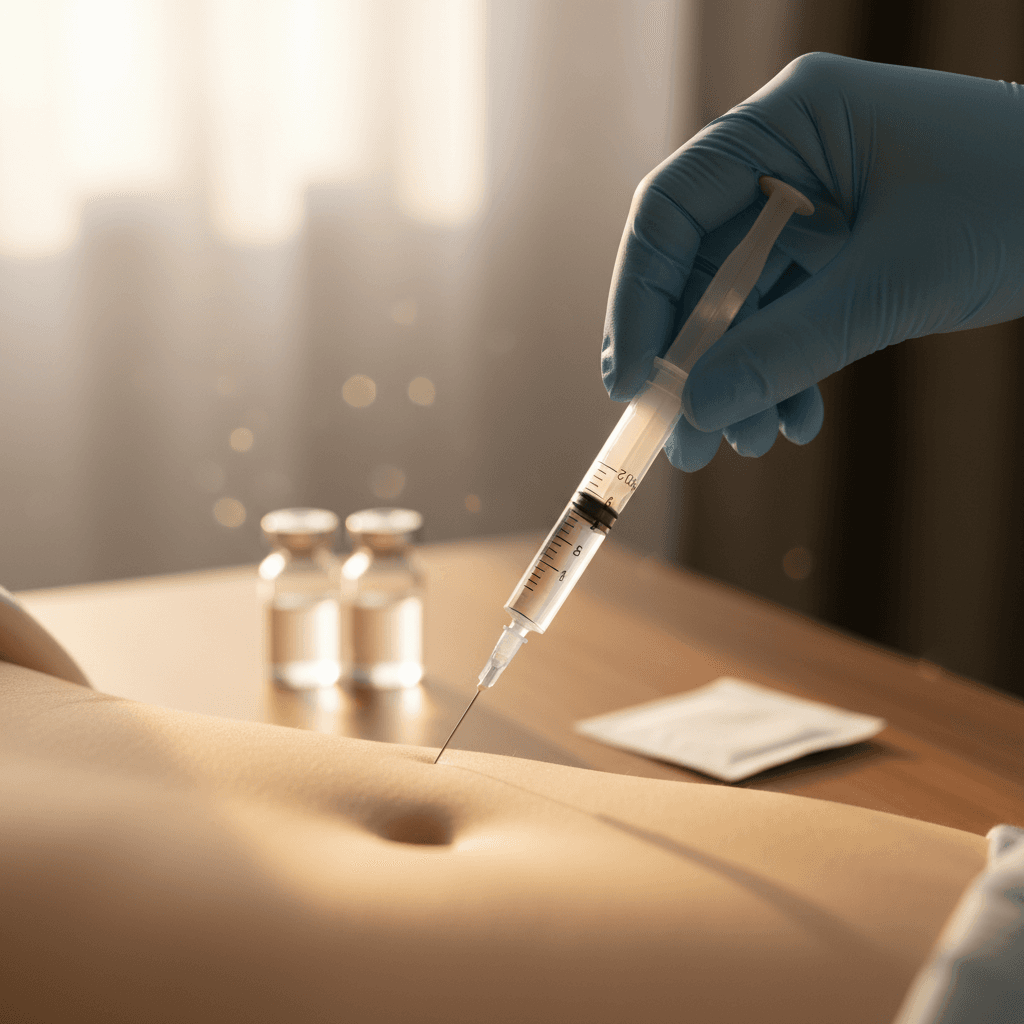
Most peptides are injected subcutaneously, into the fat tissue beneath the skin. A smaller number are injected intramuscularly, into muscle. The route of administration affects the rate of absorption, the injection technique, and the choice of needle.
Subcutaneous (SubQ) Injection
Subcutaneous injection delivers the peptide into the fat layer between the skin and the muscle. Absorption from this compartment is slower and more gradual than from muscle, which suits the pharmacokinetic goals of most peptide protocols.
Technique:
- Clean the injection site with an alcohol swab and allow it to dry.
- Pinch a fold of skin and fat between the thumb and index finger.
- Insert the needle at a 45-degree angle for 1/2 inch needles, or at 90 degrees for 5/16 inch needles.
- Release the skin pinch.
- Depress the plunger slowly and steadily.
- Wait 5-10 seconds before withdrawing the needle.
- Do not rub the site afterward. Light pressure with a cotton ball or swab is appropriate if a drop of blood appears.
The angle and technique above follow standard subcutaneous administration guidance, in which the needle is directed into the fatty tissue rather than the underlying muscle (CDC Pink Book, Chapter 6: Vaccine Administration, CDC).
For guidance on needle gauge, length, and unit markings for subcutaneous peptide injections, see the insulin syringe guide.
Common SubQ Sites
Abdomen. This is the most commonly used site. The area around the navel is suitable, staying at least 2 inches (5cm) away from the navel itself and clear of the belt line. The abdomen offers a large, accessible surface area with consistent fat depth, which is why most patients begin here.
Thigh (anterior/outer). The front or outer portion of the mid-thigh is appropriate. The inner thigh is best avoided because it contains more nerve endings and tends to be more uncomfortable. The thigh provides good surface area for rotation but can be slightly more sensitive than the abdomen.
Upper arm (posterior). The back of the upper arm, between the shoulder and elbow, is a viable site, though it is difficult to reach without assistance. The fat layer here tends to be thinner, so a shorter needle (5/16 inch) or a shallower angle is preferable.
SubQ Peptides
The following peptides are administered subcutaneously:
- BPC-157 - 1-2x daily
- Semaglutide - 1x weekly
- Tirzepatide - 1x weekly
- TB-500 - 2-3x weekly
- CJC-1295/Ipamorelin - 1x daily
- Sermorelin - 1x daily
- AOD-9604 - 1x daily
- PT-141 - as needed
- GHK-Cu - 1x daily
- DSIP - 1x daily
- MOTS-c - 3-5x weekly
Intramuscular (IM) Injection
Intramuscular injection places the peptide directly into muscle tissue. Absorption is faster because muscle is more richly perfused than subcutaneous fat. IM injections require longer needles, typically 1 inch or longer at 25g-27g, and a 90-degree angle (CDC Pink Book, Chapter 6: Vaccine Administration, CDC).
Technique:
- Clean the site with an alcohol swab and allow it to dry.
- Stretch the skin taut with one hand. Do not pinch the skin for an IM injection.
- Insert the needle at 90 degrees in a quick, dart-like motion.
- Aspirate briefly by pulling back slightly on the plunger. If blood appears, withdraw and select a new site. Aspiration is no longer routinely recommended in most clinical guidelines, although some practitioners continue to advise it for IM injections.
- Inject slowly.
- Withdraw the needle and apply light pressure.
Common IM Sites
Deltoid (upper arm). The fleshy part of the outer shoulder is suitable for small volumes, under 1ml, and is easy to access.
Vastus lateralis (outer thigh). The outer middle third of the thigh accommodates larger volumes and is straightforward to self-administer.
Ventrogluteal (hip). The side of the hip is preferred by many clinicians for its large muscle mass and low nerve density, though it is more difficult to self-administer without practice.
IM Peptides
Few peptides require intramuscular injection, and some may be given by either route:
When a peptide's administration route is listed as subcutaneous, it should be given subcutaneously. There is no clinical reason to switch to the intramuscular route without a specific indication.
Intranasal Administration
Some peptides can be administered as a nasal spray rather than by injection. This is most common with Semax and Selank, two neuropeptides that absorb well across the nasal mucosa and are intended to act on the central nervous system.
Why intranasal administration works for these peptides: The nasal cavity has a thin mucosal lining with a rich blood supply. Peptides absorbed here can partially bypass the blood-brain barrier by way of the olfactory nerve pathway, which provides a more direct route to the brain than systemic circulation for centrally acting compounds (Wen 2011, Discovery Medicine, PMID 21712015). For Semax specifically, pharmacokinetic work in rats has demonstrated penetration into brain tissue after intranasal administration (Shevchenko et al. 2006, Bioorganicheskaia Khimiia, PMID 16523722).
How to prepare a nasal spray:
- Reconstitute the peptide with bacteriostatic water in the usual manner.
- Transfer the solution into a sterile nasal spray bottle designed for this purpose, available from compounding pharmacies and some peptide vendors. Most nasal spray bottles deliver approximately 0.1ml (100mcl) per pump.
- Calculate the quantity of peptide delivered per spray based on the concentration. For example, 5mg of Semax in 2ml of bacteriostatic water yields 2,500mcg/ml, so a 0.1ml spray delivers 250mcg.
- Store the spray bottle in the refrigerator between uses.
Intranasal administration notes:
- Clear the nose before administering by blowing gently, because mucus impedes absorption.
- Direct the spray toward the outer wall of the nostril rather than straight up or toward the septum.
- Sniff gently after spraying so the mist coats the upper nasal cavity instead of draining into the throat.
- Alternate nostrils when administering multiple sprays.
- Avoid sneezing or blowing the nose for at least 5 minutes after administration.
Limitations of intranasal delivery: Not all peptides are suitable for intranasal administration. BPC-157, semaglutide, TB-500, and most other peptides discussed on this site must be injected. The nasal mucosa degrades larger peptides before they can be absorbed. Semax and Selank are effective by this route because they are small, stable peptides well suited to nasal absorption.
Injection Site Rotation
Rotating injection sites helps prevent tissue complications. Repeatedly injecting into the same location can cause:
- Lipodystrophy, presenting as hardened lumps or pitted areas in the fat tissue
- Scar tissue accumulation, which reduces absorption over time
- Localized pain or irritation, because the tissue is not given time to recover
Systematic site rotation is a core element of established injection-technique guidance and is recommended specifically to reduce the risk of lipohypertrophy (Klonoff et al. 2025, Mayo Clinic Proceedings, PMID 40180487).
Rotation strategy:
For abdominal injections, it can help to picture a clock face around the navel, with each injection moving to the next hour position. This provides 12 distinct sites on the abdomen alone. Adding the thighs and arms extends the rotation to several weeks before returning to any given spot.
A practical rule is to avoid injecting within 1 inch (2.5cm) of the previous injection site. Maintaining a consistent mental pattern, or alternating sides on each injection day, makes this easier to follow.
For daily peptides such as BPC-157 dosed twice daily, a wider rotation pattern is more important. One approach is to use the abdomen for morning doses and the thigh for evening doses.
For weekly peptides such as semaglutide, rotation is simpler. Alternating between the left and right abdomen, or between the abdomen and thigh each week, is sufficient.
Consistent site rotation is one of the most reliable ways to preserve injection comfort and absorption over the course of a long protocol.
Scar Tissue and Long-Term Rotation Strategies
For patients on a peptide protocol lasting months or, in the case of semaglutide or BPC-157 for chronic conditions, years, scar tissue becomes a genuine concern. Every needle puncture creates a small wound that heals with a microscopic amount of scar tissue. Across hundreds of injections in the same general area, that scar tissue accumulates.
How scar tissue affects injections:
- Injections become more difficult, as the needle meets resistance passing through scarred fat.
- Absorption slows, because scar tissue has less blood flow than healthy tissue and the peptide takes longer to reach the bloodstream.
- Lumps develop, sometimes palpable as pea-sized hardened spots under the skin at overused sites.
Long-term rotation strategies:
- Divide the abdomen into quadrants. Use the upper left in week 1, the upper right in week 2, the lower right in week 3, and the lower left in week 4. Within each quadrant, rotate through individual spots using the clock method.
- Add sites. Many people default to the abdomen alone. Incorporating the thighs roughly doubles the available surface area.
- Track sites used. A simple note on a phone is adequate, such as "left abdomen, 2 o'clock" or "right thigh, outer." An elaborate system is unnecessary; the aim is only to avoid returning to the same spot within 2 weeks.
- Rest overused areas. If a site feels harder or more painful than usual, avoid that entire area for at least a month.
For patients injecting twice daily, such as those following the BPC-157 and TB-500 stack, this amounts to 60 injections per month. Without deliberate rotation, tissue complications are likely. It is best to plan the rotation before beginning the protocol rather than after lumps appear.
Injection Pain Management
Most subcutaneous peptide injections are nearly painless with a 30g or 31g needle, but nearly painless is not the same as always painless. The following measures help on the occasions when an injection stings.
Before the injection:
- Allow the peptide to reach room temperature for 1-2 minutes. Cold solution taken directly from the refrigerator causes more discomfort. It should not be warmed aggressively; holding the vial in the hand for a minute is sufficient, and microwaves or hot water should be avoided.
- Numb the site with an ice cube for 15-20 seconds to reduce nerve sensitivity, then dry the area and swab with alcohol before injecting.
- Relax the muscle beneath the injection site, as tensing tightens the tissue and makes needle entry more difficult.
During the injection:
- Insert the needle in one smooth, quick motion. Hesitating or advancing slowly through the skin is more uncomfortable than a single confident insertion.
- Inject the solution slowly. Depressing the plunger too quickly forces liquid into the tissue faster than it can disperse, creating pressure and stinging. A standard dose should take 5-10 seconds.
- Do not move the needle once it is inserted. Wiggling or repositioning tears tissue and increases pain.
After the injection:
- Apply light pressure with a clean cotton ball or swab, without rubbing.
- A small drop of blood is normal and indicates a nicked capillary; bleeding stops within seconds.
- A small raised bump, or wheal, is common with subcutaneous injections. It is simply fluid sitting in the tissue before absorption and typically flattens within 15-30 minutes.
If a particular site consistently hurts more than others, the injection point may be in a nerve-dense area. Shifting the injection point half an inch in any direction usually helps. The abdomen contains points that sting and adjacent points that are barely perceptible.
Common Injection Mistakes
Injecting too shallow. If the needle barely enters the skin, the peptide is deposited in the dermis rather than the subcutaneous fat. This produces a raised, red welt that takes hours to absorb. It is not harmful, but absorption is less efficient. The needle should be fully inserted for subcutaneous injections with short needles (5/16 inch at 90 degrees).
Injecting too deep. With a 1/2 inch needle at 90 degrees in a lean person, the needle can pass through the fat and into muscle. The peptide then absorbs faster intramuscularly, which alters the pharmacokinetics. Using a 45-degree angle with 1/2 inch needles, or switching to 5/16 inch needles, keeps the injection subcutaneous.
Not letting alcohol dry. Injecting through wet alcohol stings. The alcohol needs 10-15 seconds to evaporate, so it is worth waiting for the skin to dry before inserting the needle.
Withdrawing the needle too quickly. Pulling the needle out abruptly creates a larger exit wound and can cause more bleeding. It should be withdrawn smoothly and steadily.
Injecting into bruised or irritated skin. A site that is bruised, red, or swollen from a previous injection should be avoided entirely. Injecting into damaged tissue increases pain and may reduce absorption. It is better to use a different site and allow the area to heal.
Forgetting to remove the needle cap. This may seem too obvious to mention, but it does occur. Unusual resistance on attempting to inject is a signal to check the cap rather than push harder.
References
- Centers for Disease Control and Prevention. "Chapter 6: Vaccine Administration." Epidemiology and Prevention of Vaccine-Preventable Diseases (Pink Book). https://www.cdc.gov/pinkbook/hcp/table-of-contents/chapter-6-vaccine-administration.html
- Wen MM. "Olfactory targeting through intranasal delivery of biopharmaceutical drugs to the brain: current development." Discovery Medicine, 2011. PMID 21712015. https://pubmed.ncbi.nlm.nih.gov/21712015/
- Shevchenko KV, Nagaev IIu, Alfeeva LIu, et al. "Kinetics of Semax penetration into the brain and blood of rats after its intranasal administration." Bioorganicheskaia Khimiia, 2006. PMID 16523722. https://pubmed.ncbi.nlm.nih.gov/16523722/
- Klonoff DC, Berard L, Franco DR, et al. "Advance Insulin Injection Technique and Education With FITTER Forward Expert Recommendations." Mayo Clinic Proceedings, 2025. PMID 40180487. https://pubmed.ncbi.nlm.nih.gov/40180487/