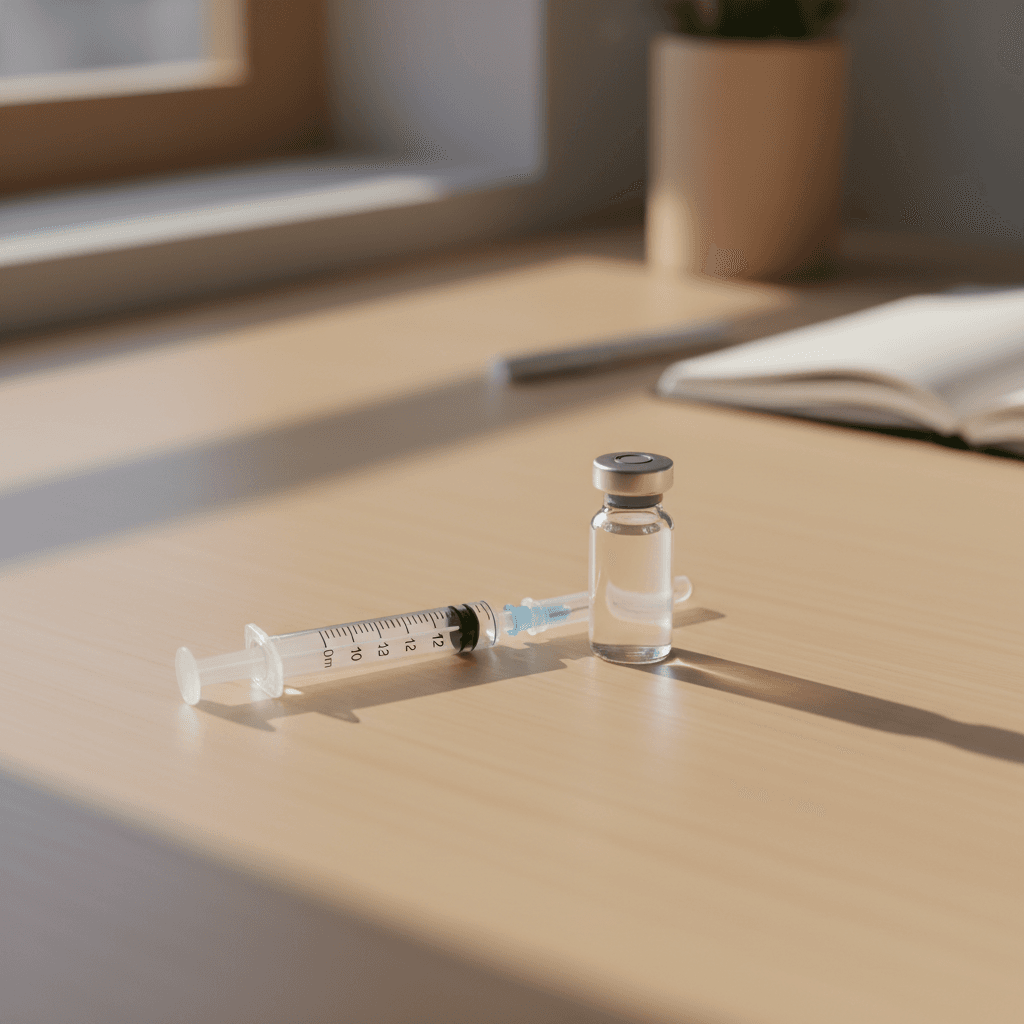
mg to mcg to ml to units
Every peptide dose calculation follows the same chain: begin with milligrams on the vial label, convert to micrograms if needed, determine how many milliliters of reconstituted solution that corresponds to, then translate milliliters into units on an insulin syringe.
Here is the relationship:
- 1 mg = 1,000 mcg
- 1 ml = 100 units on a U-100 insulin syringe (HUMULIN R U-100, DailyMed/FDA)
- Concentration = peptide amount (mg) / diluent volume (ml)
That is the entire framework. Every calculation is a matter of substituting values.
Conversion Formulas Reference
| To Find | Formula | Example |
|---|---|---|
| Concentration (mg/ml) | Total mg / Total ml | 5 mg / 2 ml = 2.5 mg/ml |
| Concentration (mcg/ml) | Concentration in mg/ml x 1,000 | 2.5 mg/ml = 2,500 mcg/ml |
| Volume to draw (ml) | Target dose (mg) / Concentration (mg/ml) | 0.25 mg / 2.5 mg/ml = 0.1 ml |
| Units to draw | Volume in ml x 100 | 0.1 ml x 100 = 10 units |
| mcg to mg | mcg / 1,000 | 250 mcg = 0.25 mg |
| mg to mcg | mg x 1,000 | 0.25 mg = 250 mcg |
Worked Examples
Example 1: BPC-157
Consider a 5 mg vial reconstituted with 2.5 ml of bacteriostatic water.
- Concentration: 5 mg / 2.5 ml = 2 mg/ml (or 2,000 mcg/ml)
- Target dose: 500 mcg (0.5 mg)
- Volume: 0.5 mg / 2 mg/ml = 0.25 ml
- Syringe: 0.25 ml x 100 = 25 units
That vial provides 10 doses of 500 mcg. Use the BPC-157 calculator to run the numbers.
Example 2: TB-500
Consider a 5 mg vial reconstituted with 2 ml of bacteriostatic water.
- Concentration: 5 mg / 2 ml = 2.5 mg/ml
- Target dose: 2.5 mg (a typical loading dose)
- Volume: 2.5 mg / 2.5 mg/ml = 1 ml
- Syringe: 1 ml x 100 = 100 units (a full 1 ml syringe)
Two doses per vial. The TB-500 calculator handles this automatically.
Example 3: Small mcg-range dose
Consider a 2 mg vial of a peptide dosed at 100 mcg, reconstituted with 2 ml of bacteriostatic water.
- Concentration: 2 mg / 2 ml = 1 mg/ml (1,000 mcg/ml)
- Target dose: 100 mcg = 0.1 mg
- Volume: 0.1 mg / 1 mg/ml = 0.1 ml
- Syringe: 0.1 ml x 100 = 10 units
Twenty doses from one vial.
Example 4: Choosing the diluent volume
The same 5 mg vial reconstituted with 1 ml instead of 2 ml:
- Concentration: 5 mg / 1 ml = 5 mg/ml
- Target dose: 0.5 mg
- Volume: 0.5 mg / 5 mg/ml = 0.1 ml = 10 units
Less water means a higher concentration, so less liquid is drawn per dose. This is useful for small injection volumes but makes precise measurement harder at very low doses.
Notes by Peptide
BPC-157
Standard vials are 5 mg. Most protocols reconstitute with 2 - 2.5 ml of bacteriostatic water. Typical doses range from 250 - 500 mcg once or twice daily. See the BPC-157 calculator.
Semaglutide
Often supplied as a pre-mixed solution with the concentration printed on the label. Do not assume the concentration matches another supplier's product; verify it every time. Doses start low (0.25 mg/week) and titrate up (Ozempic, DailyMed/FDA). The semaglutide calculator covers both lyophilized and pre-mixed forms.
TB-500
Comes in 2 mg or 5 mg vials. Loading doses are typically 2 - 2.5 mg twice per week, tapering to lower maintenance doses. See the TB-500 calculator.
CJC-1295 and Ipamorelin
These are sold as separate vials, not pre-mixed. Each is reconstituted individually with its own bacteriostatic water. A common protocol uses 100 mcg of CJC-1295 and 100 mcg of Ipamorelin, administered as two separate injections or drawn sequentially. The CJC-1295/Ipamorelin calculator handles the math for both.
GHK-Cu
Typically sold in 10 mg or 20 mg vials. Doses tend to be small (200 - 600 mcg), so add enough diluent to keep the concentration manageable for the syringe. See the GHK-Cu calculator.
Insulin Syringes
U-100 insulin syringes come in three sizes:
| Syringe Size | Total Units | Best For |
|---|---|---|
| 0.3 ml | 30 units | Doses under 0.3 ml - finest graduation marks, most precise |
| 0.5 ml | 50 units | Mid-range doses |
| 1 ml | 100 units | Larger volumes, loading doses |
Each tick mark on a U-100 syringe = 1 unit = 0.01 ml. Ten units therefore equals 0.1 ml.
When drawing from a vial, push air equal to the dose volume into the vial first, then invert and draw back to the target line. This equalizes pressure and prevents a vacuum from forming.
For a fuller breakdown of syringe types, gauges, and unit markings, see the insulin syringe guide.
Common Mistakes
Mixing up mcg and mg. A 250 mcg dose is 0.25 mg. A calculation that instead uses 250 mg is off by a factor of 1,000.
Forgetting concentration changes with diluent volume. 5 mg in 1 ml is 5 mg/ml. The same 5 mg in 5 ml is 1 mg/ml. Always recalculate after changing the reconstitution volume.
Assuming identical concentrations across suppliers. A "5 mg vial" from one source might be reconstituted differently than another. Rely on the concentration actually mixed, not on what worked previously with a different product.
Ignoring syringe dead space. At very low volumes (under 5 units), the liquid trapped in the needle hub can matter. Low dead space syringes reduce this (Zule 2018, Harm Reduct J, PMID 29334973).
Reconstitution Tips
- Aim the stream of bacteriostatic water down the inside wall of the vial, not directly onto the powder.
- Roll the vial gently between the palms. Do not shake it.
- Wait for the solution to turn completely clear before drawing doses. This usually takes 1 - 3 minutes.
- Write the concentration and reconstitution date on the vial with a marker.
- Refrigerate after reconstituting. Most reconstituted peptides stay stable for 3 - 4 weeks refrigerated.
For a full walkthrough of mixing, see the reconstitution guide for beginners, and storing reconstituted peptides for shelf-life details.
Step-by-Step Checklist
- Read the vial label for total peptide content in mg.
- Decide how much bacteriostatic water to add.
- Calculate concentration: peptide mg / water ml.
- Convert the target dose to mg if it is listed in mcg (divide by 1,000).
- Divide target dose by concentration to get ml.
- Multiply ml by 100 to get syringe units.
- Verify with our peptide calculators before drawing.
Disclaimer: This guide is for educational reference only and does not constitute medical advice. Consult a qualified healthcare provider before starting any peptide protocol.
Calculators for specific peptides:
- BPC-157 calculator
- Semaglutide calculator
- Tirzepatide calculator
- TB-500 calculator
- CJC-1295 Ipamorelin calculator
- GHK-Cu calculator
- PT-141 calculator
- Sermorelin calculator
- AOD-9604 calculator
- DSIP calculator
- Selank calculator
- Semax calculator
- MOTS-c calculator
References
- HUMULIN R U-100 (insulin human injection) Prescribing Information, DailyMed/FDA. https://dailymed.nlm.nih.gov/dailymed/drugInfo.cfm?setid=9ec3e28a-cea9-4e45-9057-e5bf8e37014c
- OZEMPIC (semaglutide) injection Prescribing Information, DailyMed/FDA. https://dailymed.nlm.nih.gov/dailymed/drugInfo.cfm?setid=e6da837c-0da0-41d6-973c-5559bf764367
- Zule WA, et al. Options for reducing HIV transmission related to the dead space in needles and syringes. Harm Reduct J. 2018. PMID 29334973. https://pubmed.ncbi.nlm.nih.gov/29334973/