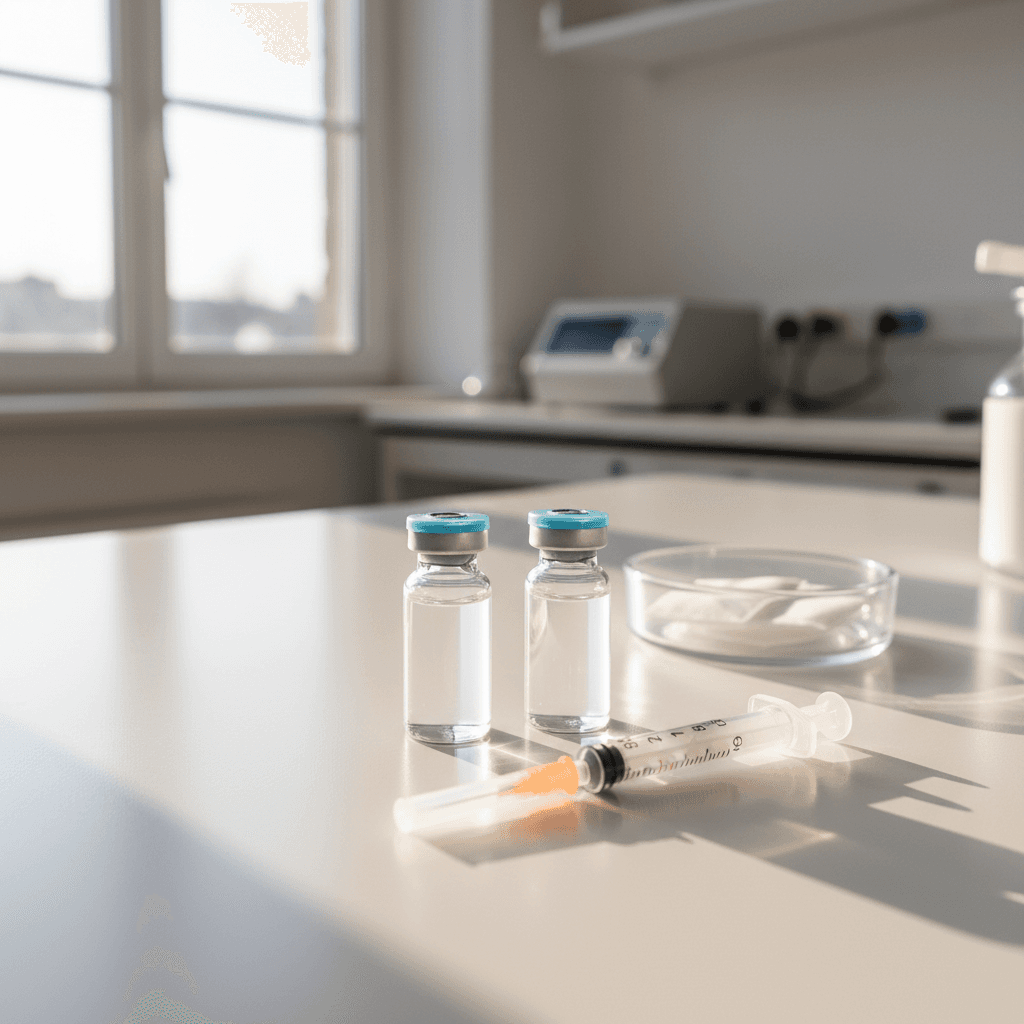
Refrigerate reconstituted peptides at 2-8°C (36-46°F) immediately after mixing. This is the single most important storage rule. Temperature control determines whether a peptide lasts its full shelf life or degrades within days.
Temperature Requirements
The target range is 2-8°C, which is a standard household refrigerator setting. Most refrigerators run at about 3-4°C. Place the vial in the main compartment, not the door. Door shelves experience wider temperature swings from repeated opening.
Avoid these temperature mistakes:
- Do not store on the refrigerator door
- Do not place directly against the back wall (risk of accidental freezing)
- Do not leave at room temperature between uses. Remove the vial, draw the dose, and return it to the refrigerator. The entire process should take under two minutes.
- Do not freeze reconstituted peptides. Freeze-thaw cycles cause aggregation and loss of potency (Jain et al. 2021, Scientific Reports, PMID 34059716).
Unreconstituted (lyophilized) peptides are more temperature-stable. They can tolerate brief periods at room temperature during shipping. Once water is added, however, degradation accelerates at higher temperatures.
Light Sensitivity
Many peptides are light-sensitive. UV and visible light can break down peptide structure over time (Kerwin & Remmele 2007, Journal of Pharmaceutical Sciences, PMID 17230445).
Protection methods:
- Keep vials in their original box or a closed container inside the fridge
- Wrap vials in aluminum foil if they will be exposed to light for any reason
- Some vendors ship peptides in amber-tinted vials, which offer partial protection
Direct sunlight will degrade a reconstituted peptide noticeably within hours. Ambient indoor light is less of a concern for brief exposures such as drawing a dose, but prolonged exposure on a countertop should be avoided.
Shelf Life by Peptide
Shelf life varies by peptide. These numbers assume proper refrigeration at 2-8°C with bacteriostatic water.
| Peptide | Reconstituted Shelf Life |
|---|---|
| BPC-157 | 28 days |
| Semaglutide | 28 days |
| Tirzepatide | 28 days |
| PT-141 | 28 days |
| TB-500 | 21 days |
| CJC-1295/Ipamorelin | 21 days |
| GHK-Cu | 21 days |
| Sermorelin | 21 days |
| AOD-9604 | 21 days |
| Selank | 21 days |
| Semax | 21 days |
| MOTS-c | 21 days |
| DSIP | 14 days |
These are conservative estimates. Some users report peptides remaining effective beyond these windows, but potency declines progressively. For consistent dosing, replace vials that have exceeded their shelf life.
Signs of Degradation
Discard a reconstituted peptide if any of the following are present:
Cloudiness. A properly reconstituted peptide should be clear. Cloudiness indicates protein aggregation or microbial contamination. Either way, the vial is compromised.
Visible particles. Floating specks, strands, or sediment mean the peptide has degraded or the solution is contaminated.
Color change. Most peptide solutions are colorless. GHK-Cu has a natural blue tint, which is normal. Any unexpected yellowing, browning, or darkening in other peptides suggests oxidation or degradation.
Unusual smell. Bacteriostatic water has a faint benzyl alcohol scent (Bacteriostatic Water for Injection USP, DailyMed). Any strong, foul, or unfamiliar odor is a sign of bacterial growth.
Smell test. Remove the cap from the bacteriostatic water vial and smell it. It should carry the faint, slightly sweet scent of benzyl alcohol. Then smell the reconstituted peptide vial. It should smell nearly identical. A sour, sulfurous, or rotten smell indicates bacterial contamination, and the vial should be discarded immediately.
Reduced effectiveness. This is the hardest sign to detect because it is subjective. When a peptide performs well for the first two weeks and then produces declining results in week three or four, degradation is a likely cause. This is normal. It does not mean the peptide was defective. It indicates that the solution is approaching the end of its effective shelf life.
When in doubt, discard the vial. Peptides are not expensive enough to justify using a potentially contaminated or degraded solution.
Peptide-by-Peptide Storage Quirks
Most peptides behave the same way in storage: keep them cold, keep them dark, and use them within their shelf life window. A few, however, have characteristics that are easy to overlook.
BPC-157. Generally the most forgiving peptide for storage. It remains stable for a full 28 days refrigerated. Some users report a very faint pinkish or blue-ish tint developing over time when BPC-157 is sourced from certain manufacturers. A slight tint is not necessarily degradation, but a solution that was clear on day one and is noticeably colored by day ten should be used quickly or replaced.
GHK-Cu. This peptide contains a copper ion, which gives the solution a natural blue tint. This blue color is expected and normal. It is not contamination. However, a blue that deepens significantly or shifts toward green or brown suggests the copper has oxidized. GHK-Cu is more light-sensitive than most peptides. Keep it wrapped in foil or in a closed box inside the fridge.
Semaglutide and Tirzepatide. Both are exceptionally stable once reconstituted. They tolerate brief temperature excursions better than most peptides, which is why the pharmaceutical versions can be held at room temperature for limited periods (Ozempic for up to 56 days and Mounjaro for up to 21 days, per their labeling) (Ozempic Prescribing Information, DailyMed; Mounjaro Prescribing Information, DailyMed). Refrigeration is still preferable for best results.
DSIP. One of the least stable reconstituted peptides. Its 14-day shelf life is not conservative. It should be used within two weeks. For a vial larger than can be consumed in that window, reconstitute only a portion and keep the remainder as lyophilized powder.
Selank and Semax. Both degrade faster when exposed to warmth. They are also commonly used intranasally from spray bottles, which means they sit at room temperature during use. For nasal spray administration, keep the spray bottle in the fridge between uses and remove it only for the few seconds needed to administer a dose.
Freezer Storage
Freezing reconstituted peptides may appear to be a logical way to extend shelf life, but for most peptides it does more harm than good.
Why freezing is generally a bad idea:
- Water expands when it freezes. This expansion can physically disrupt the peptide's structure, a process called freeze-induced denaturation.
- Ice crystals form unevenly, concentrating the peptide in unfrozen pockets. This localized high concentration can cause aggregation (Jain et al. 2021, Scientific Reports, PMID 34059716).
- Thawing the vial reverses the process, but the structural damage is already done. The result is a peptide that looks fine but has reduced potency.
- Repeated freeze-thaw cycles are especially destructive. Even one cycle can cause measurable degradation for sensitive peptides.
The exception: Unreconstituted (lyophilized) peptides can be stored in a freezer for long-term storage. The freeze-drying process already removed the water, so there is nothing to expand or form crystals. Vials that will not be used for months can be stored at -20°C in a freezer. Allow them to reach room temperature before reconstituting.
Bottom line: Refrigerate reconstituted peptides at 2-8°C and do not freeze them. A peptide that needs to last longer than its shelf life is better handled by buying smaller vials and reconstituting more frequently.
Labeling
Label every vial immediately after reconstitution. Include:
- Peptide name
- Concentration (e.g., 5mg in 2ml = 2,500mcg/ml)
- Date reconstituted
- Discard date (reconstitution date + shelf life)
A small strip of lab tape and a fine-tip marker works well. Some users write directly on the vial cap with a permanent marker.
Travel and Transport
Traveling with reconstituted peptides requires maintaining the cold chain.
Short trips (under 8 hours):
- Use a small insulated lunch bag with an ice pack
- Wrap the vial in paper towel to prevent direct contact with the ice pack (avoid freezing)
- Keep the bag closed as much as possible
Longer travel:
- Use a medical-grade travel cooler designed for insulin
- Battery-powered coolers maintain a steady 2-8°C range
- TSA and most international airport security allow injectable medications with documentation. Carry peptides in original labeled vials.
Air travel tips:
- Pack in carry-on, not checked luggage (cargo holds can freeze and temperature is not controlled)
- Bring syringes in their sealed, unopened packaging
- A letter from the prescribing provider helps, though it is rarely requested for small quantities
- Keep everything in a clear zip-lock bag for easy screening
TSA and airport security specifics: TSA allows injectable medications and associated supplies (syringes, needles, alcohol swabs) in carry-on luggage (What Can I Bring? Medical, TSA). These items do not need to be declared at the checkpoint, but keeping them visible and organized speeds things up if a bag check is triggered. Peptide vials in a small insulated bag with an ice pack will not raise issues. The ice pack must be frozen solid when entering the security line. If it has melted to liquid, TSA may confiscate it under the liquid rules.
For international travel, rules vary by country. Carry peptides in original labeled vials with the peptide name visible. A copy of the prescription or a letter from the provider is more important for international flights than domestic ones. Some countries, particularly in Asia and the Middle East, have strict rules about injectable substances. Research the destination before packing.
Recommended travel gear:
- FRIO insulin cooling wallets (use evaporative cooling, no ice needed, last 24-48 hours)
- Small hard-sided cooler bags with reusable gel packs
- Battery-powered mini coolers (for multi-day trips without reliable refrigeration)
- A digital thermometer to spot-check the cooler's internal temperature
If the cold chain is broken for more than a few hours, assume reduced potency. The peptide may still work, but its integrity cannot be verified visually. For trips longer than a few days, a hotel mini-fridge is worth arranging in advance. Most hotels have them. Call ahead if unsure.
References
- Jain K, et al. "Freeze-thaw characterization process to minimize aggregation and enable drug product manufacturing of protein based therapeutics." Scientific Reports, 2021. PMID 34059716. https://pubmed.ncbi.nlm.nih.gov/34059716/
- Kerwin BA & Remmele RL Jr. "Protect from light: photodegradation and protein biologics." Journal of Pharmaceutical Sciences, 2007. PMID 17230445. https://pubmed.ncbi.nlm.nih.gov/17230445/
- Ozempic (semaglutide) Prescribing Information, Storage and Handling. DailyMed, U.S. National Library of Medicine. https://dailymed.nlm.nih.gov/dailymed/fda/fdaDrugXsl.cfm?setid=35902e95-e00c-47ae-8f4e-ba17d41881ce&type=display
- Mounjaro (tirzepatide) Prescribing Information, Storage and Handling. DailyMed, U.S. National Library of Medicine. https://dailymed.nlm.nih.gov/dailymed/fda/fdaDrugXsl.cfm?setid=d2d7da5d-ad07-4228-955f-cf7e355c8cc0&type=display
- Bacteriostatic Water for Injection, USP Label. DailyMed, U.S. National Library of Medicine. https://dailymed.nlm.nih.gov/dailymed/drugInfo.cfm?setid=69485218-9343-952d-e053-2a91aa0ad4e8
- What Can I Bring? Medical. Transportation Security Administration (TSA). https://www.tsa.gov/travel/security-screening/whatcanibring/medical