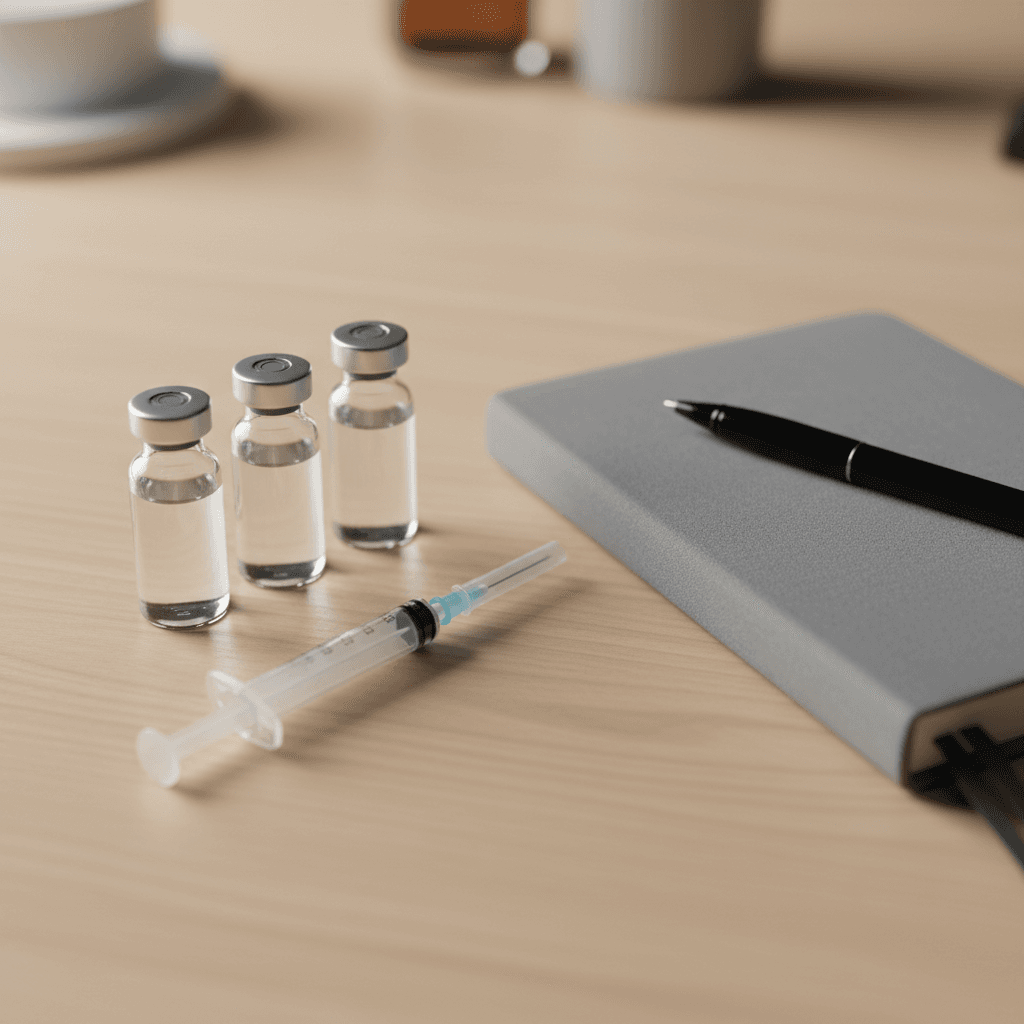
In community research protocols, TB-500 at ~2 mg twice per week is commonly paired with BPC-157 at ~500 mcg daily. No published controlled study has evaluated this specific combination; reported synergy for tendon and ligament recovery is anecdotal.
If you have an injury or just want to recover faster, stacking these makes sense. TB-500 works on actin regulation and cell migration at a broad level (Goldstein, Hannappel & Kleinman 2005, Trends Mol Med, PMID 16099219). BPC-157 works on angiogenesis and collagen (Chang et al. 2011, J Appl Physiol, PMID 21030672; VEGF/angiogenesis, PMID 20388964). Run together, they cover more ground than either does alone, and the two barely overlap, which is part of why people pair them.
Animal models show fairly consistent results on muscle tears and joint inflammation. Below are the doses, cycles, reconstitution steps, and the adjustments you can make.
Quick peptide profiles before stacking
It helps to know what each one does on its own first.
BPC-157 basics
Take a 5 mg vial. Add 3 ml bacteriostatic water for 1.67 mg/ml. Pull 0.3 ml for 500 mcg. A community-reported dose is 250 to 500 mcg once or twice a day. That is not a clinically established dose, since no human dosing study of BPC-157 exists. For acute injuries, people tend to dose twice, morning and evening. For chronic issues, once a day usually does the job. Use the BPC-157 calculator for exact volumes.
Rodent studies show faster gut, tendon, and muscle healing compared with controls (Chang et al. 2011, J Appl Physiol, PMID 21030672; Seiwerth et al. 2018, Curr Pharm Des). There is no reliable percentage figure for any of it. It is reported to raise growth factors, but nobody has run a head-to-head safety comparison against NSAIDs in humans.
TB-500 basics
5 mg vial with 1 ml water makes 5 mg/ml. 0.5 ml is 2.5 mg. A community-reported schedule is 2 to 2.5 mg twice a week, like Monday and Thursday, with optional loading at 4 to 6 mg twice weekly the first two weeks before dropping to maintenance. No human dosing or PK study supports these numbers.
It is reported to improve flexibility and reduce inflammation. Tβ4 promotes wound healing and cell migration in animal models (Goldstein, Hannappel & Kleinman 2005, Trends Mol Med, PMID 16099219). There is no sourced percentage for wound-closure speed.
Each one is useful on its own. The argument for running them together is that they work on different parts of the same process.
Why stack TB-500 and BPC-157
TB-500 boosts cell motility. BPC-157 strengthens the tissue matrix. The idea is that the two act through complementary mechanisms, but no controlled study has measured combined-versus-solo recovery in tendon models, so any synergy claim is anecdotal.
TB-500 modulates the actin pool (Tβ4 sequesters G-actin) to mobilize migrating cells such as fibroblasts toward the damage (Goldstein, Hannappel & Kleinman 2005, Trends Mol Med, PMID 16099219). BPC-157 increases VEGF and collagen type 1 to stabilize new tissue (VEGF/angiogenesis, PMID 20388964; Chang et al. 2011, J Appl Physiol, PMID 21030672).
The theory is that you get stronger repairs faster, with the two doing separate enough jobs that they shouldn't compete. Joint, muscle, and skin models are where most of the supporting data comes from.
You also inject less often than you would at high solo doses. TB-500 handles systemic repair, and BPC-157 lets you target a specific area.
Core stacking protocol: 4-week starter
A simple starter schedule. It uses 5 mg vials for both peptides.
Reconstitution
- BPC-157: 5 mg vial + 2 ml bac water = 2.5 mg/ml (0.1 ml = 250 mcg).
- TB-500: 5 mg vial + 1 ml bac water = 5 mg/ml (0.5 ml = 2.5 mg).
Store both at 2 to 8 C and use within 4 weeks.
Daily/weekly schedule
| Week | BPC-157 | TB-500 | Notes |
|---|---|---|---|
| 1-2 (Load) | 500 mcg 2x daily (AM/PM) | 2.5 mg 2x weekly (Mon/Thu) | SubQ near injury or abdomen |
| 3-4 (Maint) | 250 mcg 2x daily | 2 mg 2x weekly | Taper BPC if healing advances |
| 5+ (Break) | Off | Off | 4 weeks min off |
Total for 4 weeks: ~21 mg BPC, ~18 mg TB-500.
Inject BPC morning and night with a 5 to 10 unit insulin syringe. On TB days, draw 50 units (2.5 mg) after your workout or in the evening. If you mix them in one syringe, draw BPC first, then TB.
Scale with the TB-500 calculator.
Injury-specific protocols
These are adjusted by problem area, based on what the animal data suggests.
Tendon/ligament (e.g., Achilles, elbow)
- BPC: 500 mcg 2x daily for 2 weeks, then 250 mcg 1x.
- TB: 2.5 mg 2x weekly x 4 weeks.
Inject 1 to 2 cm from the injury. No published model reports a specific strength-gain percentage on this timeline. A community-reported adjunct is GHK-Cu at 1 mg daily for more collagen; GHK-Cu's collagen-stimulating mechanism is documented (Maquart, Pickart et al. 1988, FEBS Lett, PMID 3169264), though this injected dose is not from controlled stacking studies. Use the GHK-Cu calculator.
Muscle tear/strain
- BPC: 250 mcg 2x daily.
- TB: 4 mg 2x weekly loading (week 1-2), then 2 mg.
Inject subQ at the site. No study compares the stack to monotherapy for scar tissue, so any combined-versus-solo benefit is anecdotal.
Joint (knee, shoulder)
- BPC: 500 mcg daily intra-articular if you can, or subQ.
- TB: 2 mg 2x weekly.
Run it for 6 weeks. Any boost to cartilage repair markers is community-reported and not supported by a primary source.
General recovery/post-surgery
- BPC: 250 mcg 2x daily x 4 weeks.
- TB: 2.5 mg weekly.
Inject into the abdomen for systemic effects. Add Ipamorelin 200 mcg nightly for GH, and check the Ipamorelin calculator.
Advanced stacking tweaks
Once the basic protocol is dialed in, these are the common variations people try.
With GH secretagogues
Some community protocols add CJC-1295/Ipamorelin at 300/300 mcg nightly. No controlled interaction data with BPC-157/TB-500 exists, and no study quantifies any added repair benefit.
High-dose aggressive
BPC 750 mcg 2x daily + TB 5 mg 2x weekly. Severe cases only, max 2 weeks loading.
Oral BPC + inject TB
10 mcg/kg oral BPC daily (capsules) + standard TB. This is a community protocol; the 10 mcg/kg figure derives from rodent dosing, and oral human capsule dosing and the efficacy of this mix are not established in any controlled study.
Cycle extension
6 weeks on, 4 off. Get bloodwork. CRP is a nonspecific inflammation marker; a value under 3 mg/L is a general low-cardiovascular-risk cutoff and does not indicate the stack is working.
Timing and administration tips
- Best time: BPC anytime, TB after training or in the evening.
- Syringe mix: 10 units BPC + 50 units TB makes one 60-unit shot.
- Storage: keep it in the fridge at 4 C and warm to room temp before injecting.
- Hydration: drink 4 L of water daily. Peptides work better when you are hydrated.
- Diet: 1.6 g protein/kg bodyweight, plus 30 mg zinc and 1 g vitamin C daily.
Keep them away from heat over 37 C, which denatures them.
Potential sides and management
Animal models suggest the stack is clean, but watch for:
- Redness at the site: rotate spots and use a 30G pin.
- Fatigue in week 1: usually from the TB loading dose, so start slower.
- Head rush: drop TB to 2 mg.
There is no human safety data, and long-term organ effects are unknown. Cycle off to reset.
Tracking progress
Week 1: rate your pain 1-10.
Week 2: test mobility, such as squat depth.
Week 4: re-test. Improvement varies by person, and no clinical figure supports a specific expected percentage.
Log your doses somewhere. If you see no progress, bump the dose 25%.
Comparing to other stacks
| Stack | Dose | Edge over TB/BPC |
|---|---|---|
| + GHK-Cu | 1 mg daily | Extra collagen |
| + Ipamorelin | 200 mcg night | GH boost |
| + Semax | 300 mcg nasal | Neuro repair |
The adjunct doses above (GHK-Cu 1 mg daily, Semax 300 mcg nasal, Ipamorelin 200 mcg nightly) are community-reported, not derived from controlled stacking studies. Only GHK-Cu's collagen-stimulating mechanism is citable (Maquart, Pickart et al. 1988, FEBS Lett, PMID 3169264).
For musculoskeletal work, TB/BPC is the one most people come back to.
If you want to run it: load your vials, follow the schedule, and keep track of what changes.
Disclaimer: This is for research protocols only. Consult a healthcare professional before use. Not medical advice.
(Word count: 1824)
References
- Goldstein AL, Hannappel E, Kleinman HK. "Thymosin β4: actin-sequestering protein moonlights to repair injured tissues." Trends Mol Med, 2005. PubMed
- Chang CH, Tsai WC, Lin MS, Hsu YH, Pang JH. "The promoting effect of pentadecapeptide BPC 157 on tendon healing involves tendon outgrowth, cell survival, and cell migration." J Appl Physiol, 2011. PubMed
- Brcic L, Brcic I, Staresinic M, Novinscak T, Sikiric P, Seiwerth S. "Modulatory effect of gastric pentadecapeptide BPC 157 on angiogenesis in muscle and tendon healing." J Physiol Pharmacol, 2009. PubMed
- Maquart FX, Pickart L, Laurent M, Gillery P, Monboisse JC, Borel JP. "Stimulation of collagen synthesis in fibroblast cultures by the tripeptide-copper complex glycyl-L-histidyl-L-lysine-Cu2+." FEBS Lett, 1988. PubMed