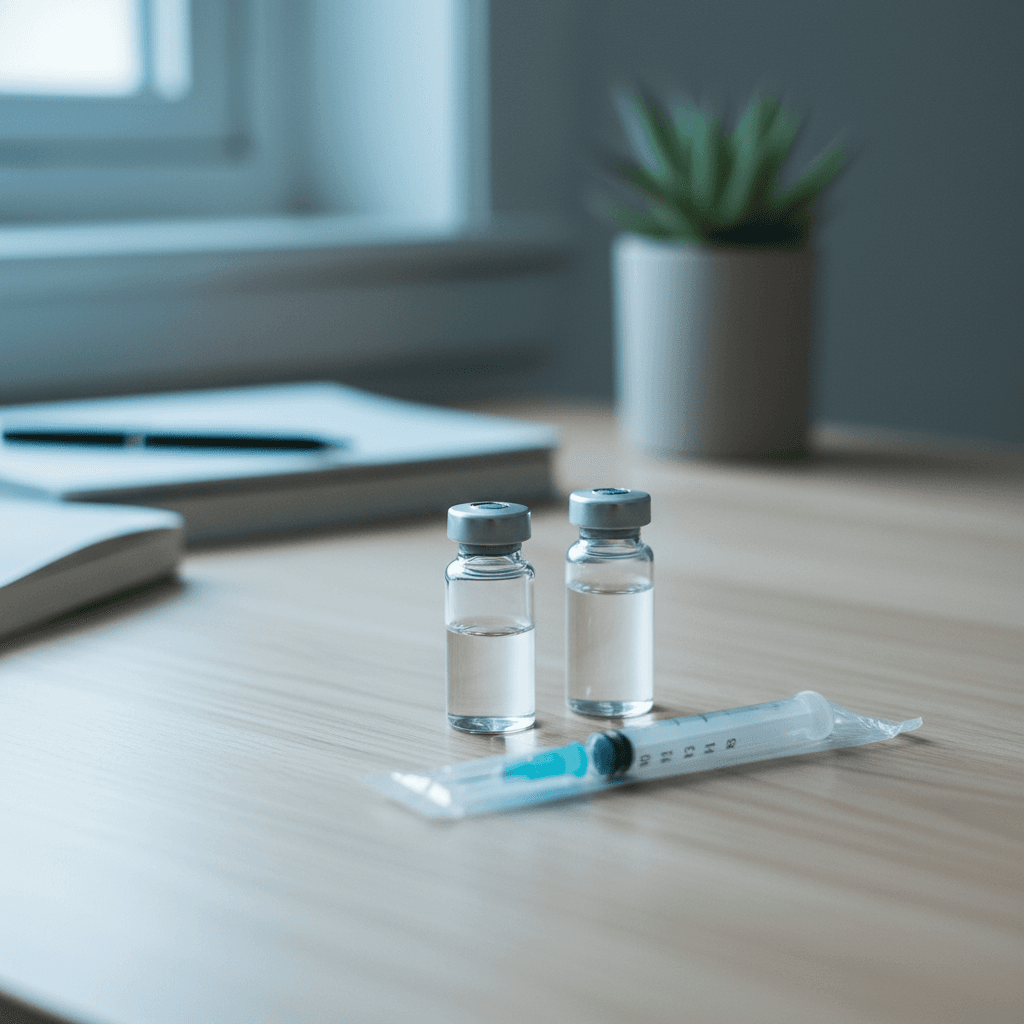
GHK-Cu comes in 5 mg, 10 mg, or 50 mg lyophilized vials for research. You reconstitute it with bacteriostatic water to reach concentrations like 5 mg/ml or 25 mg/ml, depending on your protocol.
Note on doses. The injectable doses below come from anecdotal community protocols. There is no published human subcutaneous GHK-Cu trial. Pickart's clinical work covers topical application and in-vitro fibroblast effects (Pickart 2015, PMID 26236730; Pickart & Margolina 2018, PMID 29986520). Treat the SC protocol numbers as community-reported, not validated.
GHK-Cu Reconstitution Step by Step
Take a 50 mg vial of GHK-Cu. Wipe the rubber stopper with an alcohol swab. Use a 3 ml syringe with a 25-gauge needle. Draw 2 ml of bacteriostatic water. Insert the needle at an angle and let the water trickle down the vial wall slowly. Roll the vial between your palms for 30 to 60 seconds until it clears. You now have 25 mg/ml — 1 unit on a 100-unit insulin syringe equals 250 mcg.
For a 10 mg vial, add 2 ml for 5 mg/ml. For a 5 mg vial, add 1 ml for 5 mg/ml. Always use bacteriostatic water with 0.9% benzyl alcohol to prevent bacterial growth. Store the reconstituted vial upright in the fridge at 2 to 8 C immediately.
If you draw doses, use insulin syringes marked in units. At 5 mg/ml, 6 units (0.06 ml) equals 300 mcg. Scale it with our GHK-Cu calculator.
Injectable GHK-Cu Research Dosing Protocols
Community protocols start at 200 mcg daily subcutaneously, scaling up to 600 mcg as tolerated. Inject into the abdomen or thigh, rotating sites. A common pattern is 20 to 30 days on, then a 10-day pause.
For skin repair research, the upper end of the anecdotal range sits at 500-600 mcg daily, often split as 300 mcg morning and 300 mcg evening. Protocols targeting wound healing or collagen synthesis typically run 4 weeks.
Some researchers stack with BPC-157 at 250 mcg twice daily alongside 300 mcg GHK-Cu, or with TB-500 at 2.5 mg twice weekly for tissue repair work. Use the calculators to match volumes.
| Protocol | Daily Dose | Frequency | Duration | Notes |
|---|---|---|---|---|
| Beginner Skin Repair | 200 mcg | 1x daily | 30 days | SubQ abdomen |
| Standard Collagen | 500 mcg | 2x daily (250 mcg each) | 20 days | Rotate sites |
| Wound Healing Combo | 300 mcg GHK-Cu + 250 mcg BPC | 2x daily | 14 days | With BPC calculator |
| Long Term | 200 mcg | 5 days on / 2 off | 8 weeks | Monitor progress |
Draw your dose cold from the fridge. Let it warm to room temperature for 2 minutes before injecting to reduce tissue irritation.
Topical GHK-Cu Applications in Research
Mix 10 mg GHK-Cu into 10 g of a neutral cream base like emu oil or hyaluronic acid gel for a 0.1% concentration. Apply 0.5 g (pea-sized) to face or scars twice daily. For deeper penetration, use 1%: dissolve 100 mg in 10 ml propylene glycol first, then blend into cream.
Topical research uses 0.5 to 2 ml of 1 mg/ml solution dabbed on with a dropper. Let it absorb 5 minutes before moisturizing. Protocols run 4 to 8 weeks, re-mixing fresh every 2 weeks.
For hair follicle studies, spray 1 ml of 0.5 mg/ml GHK-Cu solution on scalp nightly. Combine with microneedling at 0.5 mm depth weekly to improve absorption.
| Topical Strength | Volume per Application | Frequency | Target Area |
|---|---|---|---|
| 0.1% Cream | 0.5 g | 2x daily | Face, wrinkles |
| 1 mg/ml Serum | 1 ml | 1x nightly | Scars, wounds |
| 0.5 mg/ml Spray | 1 to 2 ml | Nightly | Scalp, hair |
Store topicals in amber glass at room temperature away from light. They last around 30 days.
GHK-Cu Storage Best Practices
Unreconstituted vials can sit at room temperature (20 to 25 C) for 2 months or in the fridge for 6 months. Once mixed, store in the fridge at 2 to 8 C for up to 4 weeks. For longer storage, aliquot 1 ml into sterile syringes and freeze at -20 C. Thaw only once — freeze-thaw cycles degrade peptide quality, though the precise loss for GHK-Cu has not been quantified in the literature.
Avoid light exposure; wrap vials in foil. If the solution turns blue-green or cloudy, discard it. Copper peptides oxidize quickly above 25 C.
For freeze-dried extras, vacuum seal and store at -80 C for up to 2 years in research freezers.
Cycling GHK-Cu for Research Continuity
Use 200 mcg daily for 30 days, then stop for 14 days. Repeat for up to 3 cycles. Higher 500-600 mcg protocols are typically limited to 20 days on, 20 off in community reports.
Some researchers pair with growth hormone analogs like CJC-1295 / Ipamorelin at 100 mcg each nightly for collagen and skin repair work.
Track progress with weekly photos for topical applications or skin thickness calipers for injectables. Adjust upward only after 10 days of no change, and stay within the 200-600 mcg/day range.
GHK-Cu with Other Peptides: Synergies
GHK-Cu is reported to stack with BPC-157 for gut and skin repair: 300 mcg GHK-Cu + 250 mcg BPC subcutaneously twice daily.
For broader regeneration, some protocols add TB-500 2.5 mg on Monday and Thursday with daily 300 mcg GHK-Cu.
Anti-aging stacks include Sermorelin 300 mcg nightly + 200 mcg GHK-Cu. Use calculators for precise reconstitution.
For nasal options, GHK-Cu is sometimes mixed with Semax for neuro-skin protocols, but subcutaneous injection is the more common route.
| Stack | GHK-Cu Dose | Partner Dose | Injection Timing |
|---|---|---|---|
| Repair Max | 500 mcg daily | BPC 250 mcg 2x | Morning / Night |
| Hair + Skin | 300 mcg daily | TB-500 2.5 mg 2x/week | Daily + loading |
| GH Boost | 200 mcg daily | CJC/Ipa 100 mcg each nightly | Night only |
Troubleshooting Common Issues
Dose feels too irritating? Dilute to 5 mg/ml with extra bacteriostatic water. A blue tint is normal — it's from the copper. Yellow or milky color indicates bacterial contamination, so discard it.
Dissolving slowly? Warm the vial in a 37 C water bath for 5 minutes, then roll it. Avoid shaking — foam degrades the peptide.
Vial pressure building up? Release it with a needle before drawing. Insulin pins clogging? Prime with 5 units of air push.
GHK-Cu Research Benefits Overview
GHK-Cu stimulates collagen synthesis in cultured fibroblasts (Maquart & Pickart 1988, FEBS Lett, PMID 3169264). Wound healing effects in animal models are documented (Pickart 2015, BioMed Res Int, PMID 26236730); specific percentage figures vary by model and tissue.
Copper binding contributes to antioxidant activity in skin cells. Topical 0.5% scalp applications have been reported in small studies; injectable hair effects have no clinical evidence base.
Effects are modest and tissue-specific. Most reports describe measurable repair after roughly 4 weeks of consistent use.
Sourcing and Quality Checks
Look for 99%+ purity verified by HPLC. Third-party certificates of analysis should list endotoxin under 1 EU/mg. Lyophilized powder should be a blue fluff, not a fine powder.
Vendors should ship with desiccant packs. Test a small vial first.
Plug your numbers into the GHK-Cu calculator for your specific vial size and target dose.
References
- Maquart FX, Pickart L et al. "Stimulation of collagen synthesis by GHK-Cu." FEBS Lett, 1988. PubMed
- Pickart L et al. "GHK Peptide as a Natural Modulator of Multiple Cellular Pathways in Skin Regeneration." BioMed Res Int, 2015. PubMed
- Pickart L & Margolina A. "Regenerative and Protective Actions of the GHK-Cu Peptide." Int J Mol Sci, 2018. PubMed
Disclaimer: This information is for research purposes only. Consult a qualified professional before using any peptides. Dosingcalc.com provides calculators as tools for hypothetical scenarios; actual use carries risks and is not endorsed.