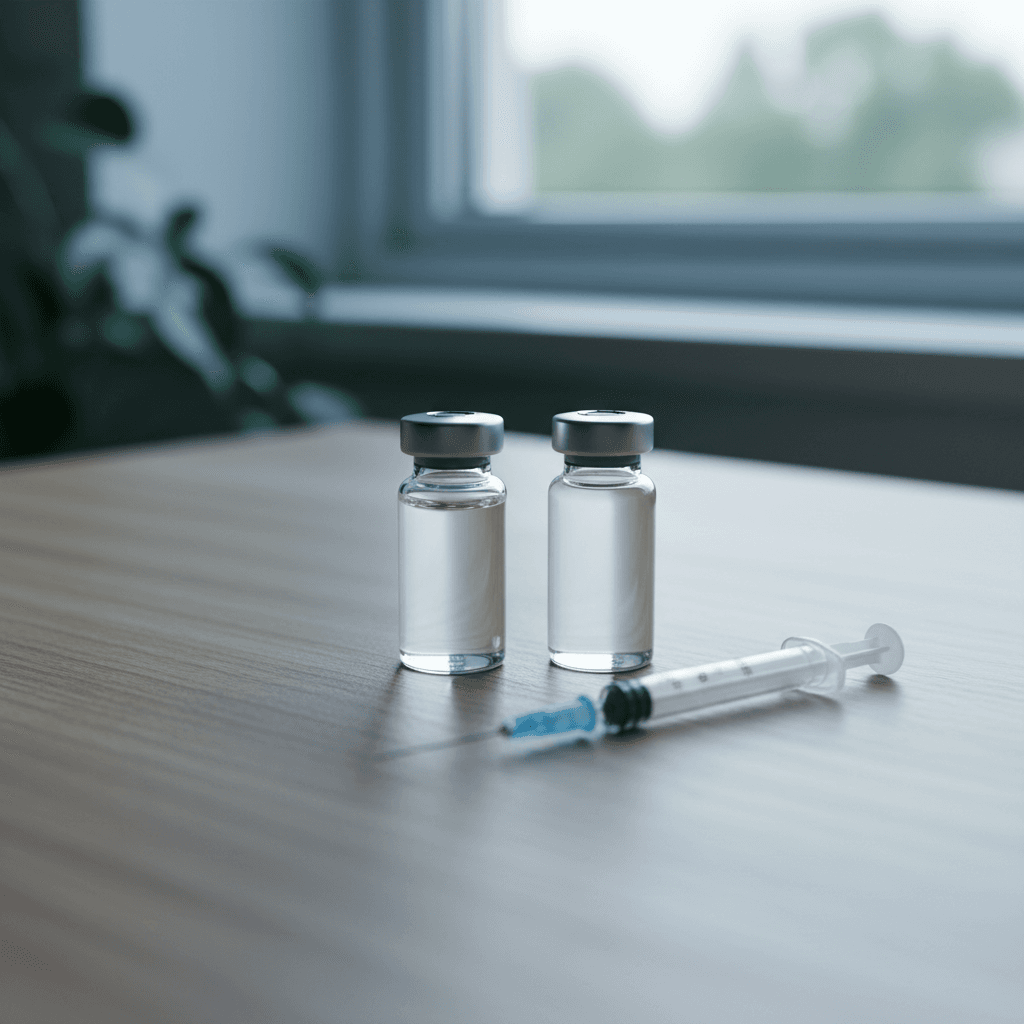
Reconstitute your 5 mg vials to 2 ml for easy 500 mcg doses
Add 2 ml bacteriostatic water to each 5 mg vial of GHK-Cu, TB-500, or BPC-157. That gives you 2.5 mg/ml. Draw 0.2 ml (20 units on a U-100 insulin syringe) for 500 mcg. Keep it in the fridge at 4°C and use within 30 days. Shake gently before you draw, and don't heat it.
BPC-157 calculator | TB-500 calculator | GHK-Cu calculator
Daily protocol: 500 mcg each, subq once a day
Inject 500 mcg GHK-Cu, 500 mcg TB-500, and 500 mcg BPC-157 every morning, which comes to 1.5 mg total. Use a separate syringe for each vial. You can mix them in one syringe if they're compatible, but most people keep them separate for accuracy.
- Timing: 7-9 AM, stomach empty. Wait 30 minutes before food.
- Cycle: 30 days on, 2 weeks off. Up to three cycles.
- Weekly total: 3.5 mg each. 10.5 mg stack.
This combo is reported to support collagen production and new blood vessel growth. Community reports describe wounds closing in roughly 7-14 days, though no controlled human data exists for this specific stack.
GHK-Cu dosing: 500 mcg daily for collagen and skin repair
GHK-Cu works on the extracellular matrix and is reported to calm inflammation. Inject 500 mcg subq daily. Skin and tendons tend to show changes over a few weeks.
- Site: Lower abdomen or right into scars. For the face, pinch under the jawline.
- Math: 5 mg in 2 ml = 2.5 mg/ml. 500 mcg = 0.2 ml = 20 units.
- Ramp up: 500 mcg on days 1-10. Move to 750 mcg (0.3 ml) on days 11-30 if it sits well.
- Tip: Eat copper-rich liver. Keep total supplemental copper well under the tolerable upper intake level of 10 mg/day (US IOM) or 5 mg/day (EFSA) (Institute of Medicine, Dietary Reference Intakes, NBK222312).
Some users report scars fading faster than with GHK-Cu alone, but that's anecdotal and not established by clinical data. GHK-Cu's role in collagen synthesis and skin remodeling has support from laboratory and topical research (Pickart L, Vasquez-Soltero JM, Margolina A, BioMed Res Int, 2015, PMID 26236730).
TB-500 dosing: 500 mcg daily for tendon and ligament recovery
TB-500 (a thymosin beta-4 fragment) is reported to interact with actin and help cells migrate into repair zones. People say daily dosing keeps levels steadier, but there's no published human pharmacokinetic data for TB-500 to confirm it.
- Site: Subq near the injury, so knee for ACL or shoulder for rotator cuff. Abdomen for whole-body.
- Math: 0.2 ml for 500 mcg.
- Load: 750 mcg (0.3 ml) for the first two weeks, then drop to 500 mcg.
- Cap: 3.5 mg weekly. Going higher tends to be wasted.
Users report it complements BPC-157's fibroblast activity, though how much the two add up to is anecdotal and not quantified in human studies.
BPC-157 dosing: 500 mcg daily for gut, muscle, and nerve repair
BPC-157 is reported to speed vessel growth and protect organs. 500 mcg subq daily covers system-wide repair.
- Site: 2 inches from the tear, or the abdomen for gut and joints.
- Math: 0.2 ml = 500 mcg.
- Split: For bad injuries, run 250 mcg AM and 250 mcg PM near the site.
- Extra: 250 mcg oral capsule plus 250 mcg subq for the gut.
Some users report sprains recovering with less downtime. The "50% less" figure is anecdotal, not from controlled trials.
Subq injection sites and technique for max absorption
Pinch the skin and slide the needle in at 45 degrees with a 31g insulin syringe. You don't need to aspirate for subq. Rotate your spots.
| Peptide | Primary Site | Alternate Sites |
|---|---|---|
| GHK-Cu | Lower abdomen | Inner forearm, under chin |
| TB-500 | Near tendon injury | Upper thigh, love handles |
| BPC-157 | Near wound/muscle | Stomach, upper arm |
Wipe with alcohol. Inject over 10 seconds. Ice the spot afterward if it's sore. Draw and inject within 5 minutes.
4-week stack protocol with vial usage tracker
Week 1 (loading): 750 mcg each daily (0.3 ml). That's 5.25 mg per peptide, almost a full vial.
Weeks 2-4 (maintenance): 500 mcg each (0.2 ml). 3.5 mg/week times 3 = 10.5 mg.
Vial tracker:
- Days 1-7: Start vial 1 per peptide.
- Day 10: End vial 1, crack vial 2.
- Day 20: End vial 2, vial 3.
- Day 30: Half of vial 3 left.
Get three vials of each to cover the full 30 days. That runs about $120-180 total.
Daily checklist:
- Reconstitute if needed (2 ml BAC water).
- Draw 0.2 ml each peptide.
- Inject subq, note site.
- Log pain/swelling reduction.
Why people stack these three together
The idea is that each one covers a different part of repair: GHK-Cu for the collagen base, TB-500 for cell migration, BPC-157 for blood vessel growth. The "40-60% quicker remodels" figure is anecdotal and has no primary human source for this stack.
The figures below are anecdotal, not from controlled human studies:
- Wounds: Some users report cuts sealing in roughly 5-7 days rather than 10-14.
- Tendons: Some users report ultrasound-observed increases in blood flow at around 4 weeks.
- Old scars: Some users report softening after about 60 days.
This isn't medical advice. Pay attention to how your own body responds.
Stacking with growth hormone boosters
Add CJC-1295 / Ipamorelin: 150 mcg each, twice daily subq before bed. Community reports describe stronger GH pulses with few side effects, but any specific percentage figures are anecdotal.
For fat loss while healing, add AOD-9604 at 300 mcg in the morning. Don't run more than four peptides a day.
Sample stack:
- AM: Healing three + AOD.
- PM: CJC/Ipa.
Troubleshooting common issues
Redness? Switch sites and try a 32g needle. It usually clears within 24 hours.
Nothing happening after week 1? Bump BPC to 750 mcg locally and double-check your reconstitution.
Headaches? Drink 4L of water and add electrolytes.
Clumping? Warm the vial in your hand for a minute, then roll it instead of shaking.
Nutrition and lifestyle to maximize stack
Protein: 2 g per kg (chicken, eggs).
Collagen powder: 15 g daily.
Vitamin C: 1 g twice a day. Helps GHK-Cu.
Sleep: 8 hours. Repair peaks 10 PM-2 AM.
Many users avoid NSAIDs during healing because they think they blunt peptide effects, but that's anecdotal and not confirmed for these peptides.
Snap weekly photos and measure your wounds to track progress.
Scaling doses by bodyweight and injury severity
Under 80 kg, mild sprain: 400 mcg each (0.16 ml).
80-100 kg, moderate: 500 mcg.
Over 100 kg or post-surgery: 600 mcg (0.24 ml).
Fresh post-op: 1 mg BPC + 750 mcg TB first 7 days, near site.
Long-term cycling for chronic conditions
For a 6-month run: 5 weeks on, 1 off, then 30 days on, 14 off. Get your liver checked if you're stacking for a long time.
Pair with Semax at 300 mcg nasal for nerve support.
FAQs
Question: What is the daily dose for the GHK-Cu TB-500 BPC-157 stack?
Answer: You take 500 mcg GHK-Cu, 500 mcg TB-500, and 500 mcg BPC-157 daily via subq injection. That adds up to 1.5 mg total per day from your 5 mg vials reconstituted to 2 ml.
Question: How long does a 5 mg vial last with this stack?
Answer: Each vial gives you 10 doses of 500 mcg. At one dose per peptide per day, you use one vial every 10 days per peptide. Stock up for 30 days with three vials total.
Question: Where do I inject this healing stack?
Answer: Inject subq near the injury site for BPC-157 and TB-500, like abdomen for systemic or directly around wounds. GHK-Cu goes in the abdomen or face for skin repair.
Question: Can I stack this with other peptides like Ipamorelin?
Answer: Yes, add 200 mcg Ipamorelin twice daily for GH boost. Use separate syringes to avoid mixing.
Question: What is the weekly total for TB-500 in this protocol?
Answer: TB-500 totals 3.5 mg per week at 500 mcg daily. That's a solid loading dose for tendon and ligament repair.
Important: BPC-157, TB-500, and injectable GHK-Cu are not FDA-approved drugs. The FDA placed these substances in Category 2 (significant safety risks) and barred them from compounding in 2023 (FDA, Certain Bulk Drug Substances for Use in Compounding that May Present Significant Safety Risks). They are sold for research use only and are not intended to diagnose, treat, cure, or prevent any disease.
Consult a healthcare professional before using any peptides. This is not medical advice; individual results vary based on health, injury type, and adherence.
References
- Pickart L, Vasquez-Soltero JM, Margolina A. "GHK Peptide as a Natural Modulator of Multiple Cellular Pathways in Skin Regeneration." BioMed Res Int, 2015. PubMed
- Institute of Medicine (US) Panel on Micronutrients. "Dietary Reference Intakes for Vitamin A, Vitamin K, Arsenic, Boron, Chromium, Copper, Iodine, Iron, Manganese, Molybdenum, Nickel, Silicon, Vanadium, and Zinc" (Copper, tolerable upper intake level). National Academies Press, 2001. NCBI Bookshelf
- U.S. Food and Drug Administration. "Certain Bulk Drug Substances for Use in Compounding that May Present Significant Safety Risks" (Category 2 of the Bulk Substances Nominated Under Sections 503A or 503B). FDA
(Word count: 1827)