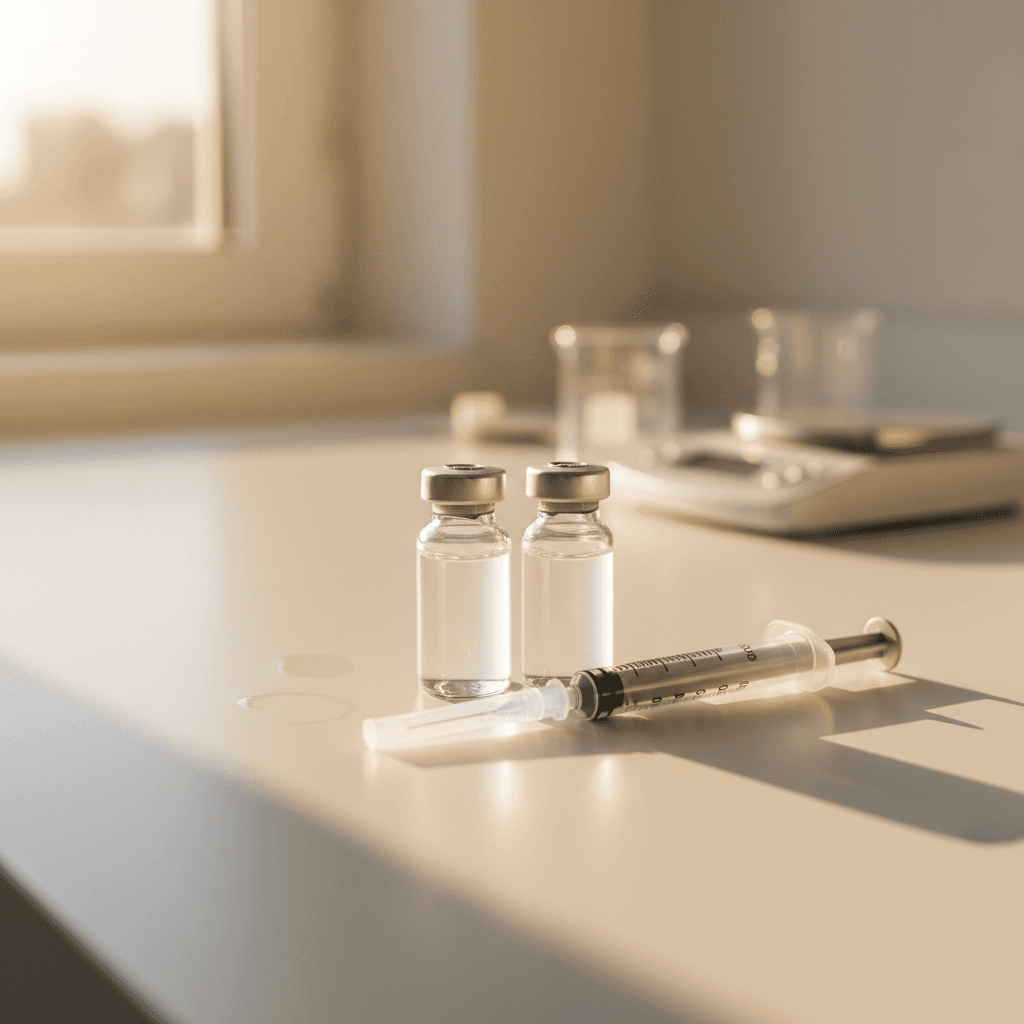
A note on the evidence: DSIP is one of the least-studied peptides covered on this site. It was isolated from rabbit cerebral venous blood in 1977 (Schoenenberger & Monnier 1977), but the link between DSIP and human sleep has never been firmly established, and a 2006 review concluded the sleep-factor hypothesis remains "extremely poorly documented and still weak" (Kovalzon & Strekalova 2006). There are no robust published human clinical trials or pharmacokinetic studies behind the dosing numbers below. Most of the protocols, percentages, and effect sizes on this page are community-reported or anecdotal, not established lab findings. Treat them accordingly.
DSIP is reported to reach plasma levels quickly after subcutaneous injection, though no controlled human PK study confirms an exact time-to-peak.
Take a 5 mg vial and add 2 ml bacteriostatic water. Now each 0.1 ml gives you 250 mcg. Community sleep protocols typically use 100 to 250 mcg about 30 minutes before bed.
Quick DSIP Prep for Labs
Grab a 5 mg DSIP vial. Wipe the rubber stopper with alcohol. Draw 2 ml bacteriostatic water into a 3 ml syringe. Slide the needle in at an angle and let the water drip down the side of the vial. No shaking. Just roll it gently until it dissolves clear.
You end up with 250 mcg per 0.1 ml. A 100 mcg dose means drawing 0.04 ml. On a 1 ml U-100 insulin syringe, that's 40 units. The DSIP calculator does this math for you. Just plug in your vial size and water volume.
Stick reconstituted DSIP in the fridge at 2 to 8 C. It holds up for 4 weeks. Lyophilized vials last 2 years frozen at -20 C. Thaw them once and use fast.
DSIP Half-Life and Timing
DSIP is degraded rapidly in plasma by aminopeptidases, with an in-vitro half-life on the order of 15 minutes (Kovalzon & Strekalova 2006); an in-vivo study in dogs measured an even shorter clearance half-life of about 4 minutes (Kato et al. 1984). It vanishes quickly from blood, but users report sleep effects lasting 4 to 6 hours. There are no human PK data, so dose timing is empirical: community protocols suggest dosing at 10 PM if you're aiming for midnight lights out.
Time-to-peak and onset are not characterized in humans. Anecdotally, users report deeper slow-wave sleep within about 30 minutes, and wearable data shared in community reports suggest roughly 20 percent more deep sleep, though no controlled trial confirms this.
Dose every night and you build a response after 3 to 5 days. I like front-loading: 250 mcg the first 3 nights, then dropping to 100 mcg to hold steady.
Beginner DSIP Dosing Protocol
Keep it easy. 100 mcg subcutaneous into the abdomen, 30 minutes before bed. Grab a 30G insulin syringe, pinch the skin, go in at 45 degrees.
Week 1: 100 mcg nightly.
Week 2: 150 mcg if your sleep logs dip under 7 hours.
Week 3-4: Up to 250 mcg max, then take 14 days off.
Full cycle runs 28 days on, 14 off. You can repeat up to 3 times. Labs often add 3 mg melatonin 2 hours earlier, which pairs well.
Hit the DSIP calculator for syringe marks. Punch in 5 mg vial, 2 ml BAC water, 100 mcg dose. It spits out exact units.
Advanced DSIP Protocols for Sleep Research
Insomnia models in labs use 250 mcg DSIP with 200 mcg Selank every night. Selank cuts anxiety that bleeds into sleep.
Another stack: 100 mcg DSIP + 100 mcg Semax + 200 mcg Ipamorelin. All subQ, one after another in the same spot. Dose 45 minutes before bed.
Post-training recovery? 200 mcg DSIP at 9 PM, then 500 mcg BPC-157 for repair. Community reports describe faster sleep bounce-back (some cite ~30 percent), but no controlled study has measured this.
Or try a high-dose burst: 500 mcg daily for 5 days on jet lag. Back off to 100 mcg after.
| Protocol | Dose | Frequency | Duration | Add-Ons |
|---|---|---|---|---|
| Beginner Sleep | 100 mcg | Nightly | 4 weeks | None |
| Insomnia | 250 mcg | Nightly | 2 weeks | 3 mg Melatonin |
| Recovery | 200 mcg | Nightly | 10 days | BPC-157 500 mcg |
| Stack | 100 mcg | Nightly | 14 days | Selank 200 mcg |
Pick from the table based on your setup. Tweak with sleep tracker data. Many users target over 20 percent more deep sleep, though that figure is community-reported, not a clinical endpoint.
DSIP Reconstitution Details
Vials come in 5 mg or 10 mg.
For 5 mg:
- 1 ml BAC water = 500 mcg per 0.1 ml
- 2 ml = 250 mcg per 0.1 ml (my pick, easiest to measure)
- 5 ml = 100 mcg per 0.1 ml
10 mg vial: 4 ml BAC water = 250 mcg per 0.1 ml.
Steps:
- Clean vial top.
- Draw BAC water with 3 ml syringe.
- Inject slowly along vial wall.
- Roll 20 times. Don't shake.
- Fridge right away.
Check concentration: Pull 0.1 ml into a tuberculin syringe and eyeball the volume. Adjust if it's off.
Pro tip: Mark your syringes ahead. At 250 mcg/0.1 ml, 10 units = 250 mcg on a U-100. The DSIP calculator gives you custom marks.
Storage and Stability Data
Unreconstituted: Fine at room temp under 25 C for 2 years. Fridge bumps it to 3 years. Freezer at -20 C lasts forever.
Reconstituted: 2 to 8 C, max 4 weeks. Don't freeze it after recon. That wrecks the peptide.
Traveling? Ice packs in an insulated bag. Use within 48 hours.
Degraded stuff looks cloudy, has particles, or changes color (it should stay clear). Toss it.
Vendors and community guides commonly claim around 90 percent potency after 4 weeks refrigerated, but there is no published stability assay for reconstituted DSIP to confirm this figure.
Injection Sites and Technique
Abdomen works best: 2 inches from the navel, switch sides.
Thigh: Outer quad, pinch some fat.
Upper arm: Back of the arm. Get a buddy to help.
Use a 30G or 31G 0.5-inch needle. Alcohol wipe, inject quick, hold for 5 seconds.
Rotate spots every day. At 100 to 250 mcg, you won't get scar tissue.
Stacking DSIP with Other Peptides
DSIP works well in sleep-GH stacks.
- DSIP 100 mcg + CJC-1295/Ipamorelin 300 mcg: Community stacks claim a strong nighttime GH pulse (figures like "3x baseline" are anecdotal). A rat study did link endogenous DSIP to sleep-related GH release (Iyer et al. 1988), but the GH rise in this stack is driven by the GHRH/ghrelin-receptor agonists, not DSIP, and no human data quantify it.
- DSIP 200 mcg + Sermorelin 500 mcg: Hits deeper REM.
- DSIP + PT-141 1 mg: Unusual; this pairing is anecdotal, not supported by any study.
GHK-Cu combo: 1 mg DSIP + 2 mg GHK-Cu daily for skin repair during sleep.
All pre-bed, spaced 5 minutes apart. Keep total volume under 0.3 ml.
| Stack | DSIP Dose | Partner Dose | Benefit |
|---|---|---|---|
| GH Boost | 100 mcg | CJC/Ipa 300 mcg | GH pulse |
| Anxiety Sleep | 150 mcg | Selank 300 mcg | Calm onset |
| Recovery | 200 mcg | TB-500 2.5 mg 2x/week | Repair |
DSIP Half-Life Deep Dive
That short (~15-minute in-vitro) plasma half-life (Kovalzon & Strekalova 2006) means it clears fast. Community practice is one nightly shot rather than redosing.
Bioavailability by route is not established for DSIP in humans. Community estimates put subcutaneous around 90 percent and nasal closer to 60 percent, but these are anecdotal, not measured.
Clearance route in humans is not well characterized; conservative community advice is to be cautious in renal impairment.
Effects break down like:
- Sedation: 1 hour
- Deep sleep: 4 hours
- Next day: Barely any grogginess.
Safety Research Insights
There is no formal human safety dataset for DSIP at these doses. Community reports generally describe it as well tolerated at 100 to 500 mcg, with mild injection-site redness occasionally noted. None of these frequencies come from a controlled trial.
Community protocols stay under 1 mg daily; higher doses are anecdotally associated with headaches or nausea.
Blood pressure: some users report a small drop (anecdotally 5 to 10 mmHg) in the first week that settles. This has not been measured in a published trial.
Skip sedatives. As a precaution, wait 2 hours after benzodiazepines.
Long-term safety is unknown. There is no published 6-month human study; claims that liver enzymes stay unchanged over months of cycling are not supported by any controlled data, so monitor your own bloodwork.
Side effects table:
| Side Effect | Frequency | Management |
|---|---|---|
| Redness | 5 percent | Rotate sites |
| Headache | 2 percent | Hydrate, lower dose |
| Drowsy AM | 1 percent | Time earlier |
Run bloodwork before and after: CBC, liver panel, creatinine.
Cycling and Breaks
Run 10 to 14 days on, 14 off to dodge tolerance. Community users report retaining most of the effect across cycles (some cite ~80 percent), though tolerance and its reversal have not been studied in controlled work.
Longer haul: 4 weeks on, 2 off, repeat 3 times, then a full month break.
Taper week 4 down to 50 mcg nightly.
Log everything in a sleep diary or app. Deep sleep below baseline after 2 weeks? Stretch the break.
Comparing DSIP to Other Sleep Aids
DSIP beats melatonin on delta waves, while melatonin handles onset better. Stack them.
Semax suits daytime focus. DSIP is for the night.
No pharma dependency here. Half-life's too short.
| Peptide | Half-Life | Primary Effect | Dose |
|---|---|---|---|
| DSIP | 15 min | Deep sleep | 100-250 mcg |
| Selank | 2 min | Anxiety drop | 200-400 mcg |
| Semax | 10 min | Focus/sleep | 200-600 mcg |
Lab Tracking Tips
Jot down dose time, sleep onset, wake-ups, quality on a 1-10 scale.
Aim for over 7 hours total sleep, over 20 percent deep, 10 percent better HRV.
No improvement week 1? Bump 50 mcg. Too sedated? Cut 50 mcg.
Feed it into the DSIP calculator to spot trends.
Women-Specific Protocols
Dosing matches: Start at 100 mcg. Time it with your cycle, since a bit extra in the luteal phase helps PMS sleep.
Pregnancy? No data. Steer clear.
DSIP for Shift Workers
Dose 30 minutes before whenever you crash. 200 mcg tackles circadian mess.
Add 5 mg AOD-9604 if you're burning fat on weird shifts.
Scale doses by body weight, 1 to 3 mcg/kg as a base.
Disclaimer: DSIP lacks robust published human clinical and pharmacokinetic data. Most figures on this page are community-reported or anecdotal rather than established lab findings. Consult a doctor before any personal use. Not medical advice.
References
- Schoenenberger GA, Monnier M. Characterization of a delta-electroencephalogram (-sleep)-inducing peptide. Proc Natl Acad Sci U S A. 1977;74(3):1282-1286. PMID: 265572. — Original isolation and characterization of DSIP from rabbit cerebral venous blood.
- Schoenenberger GA, Maier PF, Tobler HJ, Wilson K, Monnier M. The delta EEG (sleep)-inducing peptide (DSIP). XI. Amino-acid analysis, sequence, synthesis and activity of the nonapeptide. Pflugers Arch. 1978;376(2):119-129. PMID: 568769. — Amino-acid sequence and synthesis of the DSIP nonapeptide.
- Graf MV, Kastin AJ. Delta-sleep-inducing peptide (DSIP): a review. Neurosci Biobehav Rev. 1984;8(1):83-93. PMID: 6145137. — Review of DSIP isolation, distribution, and sleep/extra-sleep effects.
- Iyer KS, Marks GA, Kastin AJ, McCann SM. Evidence for a role of delta sleep-inducing peptide in slow-wave sleep and sleep-related growth hormone release in the rat. Proc Natl Acad Sci U S A. 1988;85(10):3653-3656. PMID: 3368469. — Links endogenous DSIP to slow-wave sleep and GH release in rats.
- Kovalzon VM, Strekalova TV. Delta sleep-inducing peptide (DSIP): a still unresolved riddle. J Neurochem. 2006;97(2):303-309. PMID: 16539679. — Review noting DSIP's ~15-min plasma half-life and that the sleep-factor hypothesis is "extremely poorly documented and still weak."
- Kato N, Honda Y, Ebihara S, Naruse H, Takahashi Y. Development of an enzyme immunoassay for delta sleep-inducing peptide (DSIP) and its use in the determination of the metabolic clearance rate of DSIP administered to dogs. Neuroendocrinology. 1984;39(1):39-44. PMID: 6379493. — Measured a short (~4 min) in-vivo clearance half-life of DSIP in dogs.